Friday, August 20, 2010

Reading Notes on Cloud Atlas, Pt. 3: Discuss

| 4 comments:
Just as I expected, this book made for great book club discussion. Everyone had an opinion. Everyone preferred certain segments over others. Everyone had a unique experience with the book.

But figuring out how to sum it all up is proving more difficult than I thought.

In fact, the publisher clearly couldn't even sum it up, as the back cover blurb reads:

"A postmodern visionary who is also a master of styles and genres, David Mitchell combines flat-out adventure, a Nabokvia love of puzzles, a keen eye for character, and a taste for mind-bending philosophical and scientific speculation in the tradition of Umberto Eco and Philip K. Dick. The result is brilliantly original fiction that reveals how disparate people connect, how their fates intertwice, and how their souls drift across time like clouds across the sky."

Have you ever read such a summary that says absolutely nothing?

So it may just have to come down to this: Cloud Atlas cannot be summed up. To get something out of it, Cloud Atlas requires a discussion or analysis or maybe a re-read if you have no one to discuss with.

The one thing most of us could agree on is that Mitchell used a unique format to tell the story (some found it more appealing than others; some found it gimmicky). Because each story is told in a different genre of literature, chances are you'll find one that is appealing to your reading tastes. Historical fiction, noir thriller, sci-fi...it's quite the variety. To me, splitting the stories in half increased the appeal, as each was left as a cliffhanger begging me to finish. And in my experience, I was much more interested the second time around, when things started to come together.

While pieces of individual stories came together, they never really came together as a whole. We were left questioning, "OK. What was the point of all that?" While I understand his overall point to the novel, why did it take him 509 pages to say what he pretty much concluding on the last page? Mitchell apparently isn't one to blatantly point things out; it's subtle and somewhat open to interpretation.

Like this comet birthmark I mentioned earlier. What was the point of that? Not much, except to hint that this one soul reincarnated. But that was apparently a literary reference to a Japanese (?) work, of which I would've had zero clue. See why I say this is too smart for me? And I still have to question why things like that are necessary. So that pretentiously smart people can discuss and impress themselves and each other when they catch a literary reference?

One conclusion we seemed to come to was that this was a book amount moments. It's a collection of stories where we don't necessarily get an entire picture of the characters and situations. We can't say we really know all the characters Mitchell created. All are faced with decisions; some choose the high moral ground and some don't. It doesn't necessarily tell us their character, instead merely how they reacted in a certain moment. And we see how these moments and decisions affect the future, even in the tiniest ways.

There are a lot of themes thrown around; things like power (though I would like the woman who said that to please explain rather than throw around the word "power") and greed and morals and human behavior and, essentially, the self-destruction of the human race. Pretty big, discussion-worthy ideas. But is this book going to be considered a master work of literature in ten years? Eh. As someone noted, it's very a much a work of the early 2000s. Whatever that means.


[Read my earlier thoughts on Cloud Atlas: Part 1 and Part 2.]

Wednesday, August 18, 2010

In Conclusion: But really...IS Everything Going to Be Great?

| 1 comment:
Oh, Europe. Your beauty and allure mask the epic amount of trouble you hold in store for young American travelers. We pack our bags and book our hostels with complete confidence that since you are also a developed, Western continent, we will have no problem with your languages, your people, or your customs. What deceit. At least in the experiences of Rachel Shukert.

Shukert's newest and second memoir, Everything Is Going to Be Great: An Underfunded and Overexposed European Grand Tour, logs her experiences and misadventures in Europe (though "European Grand Tour" may not be the most accurate subtitle, as this book is 90% about her time living solely in Amsterdam after an acting gig fell through).

So how is Rachel's life across the pond? Well, she's living on the couch of her gay-couple friends; she has no visa; the only work she can get is as a promoter at an American club, but she's still absolutely broke. Rachel certainly attracts drama and not really the kind that she instigates. Shit just happens to her, and apparently, it always has (alcohol may or may not always be a factor). Naturally, she's got a few good stories to tell—Like the time she dated an older man whose father was probably in the Gestapo. And the time she almost got three-way date-raped by a couple of Italian dental students, simply to get a crown replaced.

Here's my thing about memoirs—my opinion of them is changing. I've always enjoyed them while my boyfriend hates them, claiming they're too self-indulgent. I guess up to this point, I've mostly read ones that are more than just an individual's personal experiences. Instead, they seem to be one's personal account or observation of something bigger than themselves—maybe a poignant historical moment or a unique setting/environment. And I like those, because it's not all "ME ME ME!"

This one is a more on the "ME ME ME!" end of the spectrum when it comes to memoirs, but that's not to say it doesn't have its merits. It is funny. Shukert's storytelling ability leads you quickly from beginning to end with ease, sometimes causing you to laugh out loud and sometimes just to shake your head. But it's also overly crude at times, which I'm not particularly a fan of, and a lot of the time I was wondering, "Ok, what is her point?" What did she learn from all these experiences? What is all this "me me me" stuff leading up to?

The whole time, Shukert is working under the notion that Europe is the place to go in your early twenties to find yourself and discover how to live in the real world and deal with real adult things after college. That is a rough time, believe you me. And I'm sure that if I wrote a memoir about my own experiences after college, no one would read it because it would certainly have the whining but without the humor or crazy stories. The last couple of chapters, for me, redeemed a novel that could have easily veered in the "entertaining but empty" category, because Shukert does have a "what I learned" moment that is so überly coming-of-age.

I certainly enjoyed Shukert's book more than the-queen-of-self-indulgent-memoir-writing Julie Powell garbage. I certainly liked her more than I like Julie Powell. She thankfully lacked the incessant whining of Powell, and had a more, "Well this is what happened," angle than one that begged for empathy. She told things as they were without any kind of self-reflection, which was actually pretty refreshing and made the story more entertaining because I didn't have time to decide whether I really liked her as a person or not—I just "listened" to her story and laughed along with her. But at a certain point, it's like you're talking with a friend who won't shut up, and you just want to get a word in. And in this case, that word was, "Put down the bottle and pull yourself together!"

I think the true moment of crossing over into adulthood—and what may have been the aHA! moment for Rachel, as well—is when you take action to do what you need to do instead of what you think you should be doing. Like, sure, you want to live in Europe and have this great journey of self-discovery and be able to tell everyone in twenty years about the wonderful time you spent living abroad. But the world may just be telling you no—go home, regroup, and deal with what is. And luckily for Rachel's health and sanity, she listened.


Review copy provided by the publisher at BEA.

Tuesday, August 10, 2010

Reading Notes on Cloud Atlas, Pt. 2: A Quick Conclusion

| 7 comments:
I finished it, all 509 pages. It only took me an absurd ten or so days. My process of reading this book can best be illustrated by two different graphs:

A) Reading speed in relation to pages read


B) Interest level in relation to pages read

It was that dead zone in the middle there, which you may recall consisted of dystopian and post-apolyptic sci-fi, that killed me. However, quickly after I got past page 326, I was into it again and finished the rest of the book in a night. I most enjoyed stories 2, 3, and 4. Number 3—"Half-Lives: The First Luisa Rey Mystery"—was a thriller that kept me interested just by the fact that it was a thriller. Number 4—"The Ghastly Ordeal of Timothy Cavendish"—involved a crazy old man and his escape from a nursing home, so that was just humorously entertaining. The author from story number 2—"Letters from Zedelghem"—amused me. The picture in my head was of Tom Hulce's bat-crazy Amadeus from the 1984 movie of the same title.

Once the sixth story—"Sloosha's Crossin' an' Ev'rythin' After"—ends, Mitchell goes back through the other five stories and wraps each of them up with a pretty little bow.

[That's not sarcasm; he actually does conclude each of them to my satisfaction.]

The intent of all these stories, I think, is to say something to the effect that souls pass through time, and all of these characters are linked, both physically (as I discussed earlier in telling how the stories link together) and metaphysically. Though, Mitchell does tell these stories as a storyteller, and you're kinda (or at least I was kinda) left trying to rummage through all you've learned and figure out what was fact and what was fiction.

The final pages of "The Pacific Journal of Adam Ewing" are actually pretty poignant, and I think get Mitchell's entire point across—Human nature doesn't change, and we can only take things so far before they explode and we have to start all over again. Like, we started out as lawless primitives and eventually we'll drive ourselves to that again (?).

Who knows. That's what I got from it. Once we discuss in book club, I'm certain my thoughts will be much better articulated.

But until then, there were a couple passages that both seemed important and that I enjoyed:

"Oh, once you've been initiated into the Elderly, the world doesn't want you back...We—by whom I mean anyone over sixty—commit two offenses just by existing. One is Lack of Velocity. We drive too slowly, walk too slowly, talk too slowly. The world will do business with dictators, perverts, and drug barons of all stripes, but being slowed down it cannot abide. Our second offence is being Everyman's memento mori. The world can only get comfy in shiny-eyed denial if we are out of sight" (p. 361).
"Exposition: the workings of the actual past + the virtual past may be illustrated by an event well known to collective history, such as the sinking of the Titanic. The disaster as it actually occurred descends into obscurity as its eyewitnesses die off, documents perish + the wreck of the ship dissolves in its Atlantic grave. Yet a virtual sinking of the Titanic

[Go back to Part 1 of my Cloud Atlas journey or continue to Part 3.]

Thursday, August 5, 2010

My epic love for Anne of Green Gables

| 11 comments:
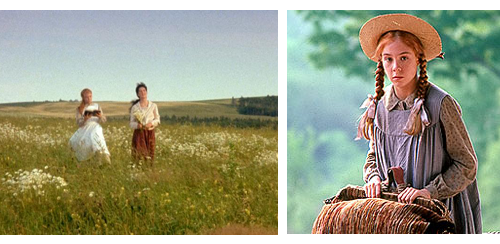
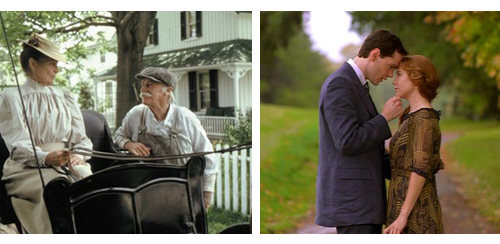
Last weekend, to rest up and save money before the epic upcoming weekend I will be spending in Chicago at Lollapalooza, I spent a good portion of my time sitting in my bed watching the Anne of Green Gables miniseries on DVDs. Ah, Anne. My love began circa 1989 when the CBC miniseries was aired on PBS Ch. 8 (yes, I still remember the local channel number). As a four-year-old, I'd curl up on my big sister's bed when she was out (she was 17, so that was often), in her room that was painted pink and full of high school memorabilia, and watch Anne of Green Gables on her little portable black and white T.V. with an antenna and a channel dial.

At least, that is how I remember it. It's very possible that I'm crossing memories and didn't actually first watch the Anne of Green Gables movies while in my sister's room, rather at school or daycare, but that is how I like to think of it.

Regardless of how the introductions actually happened, Anne of Green Gables and I have been friends for a long time. [I've wanted to go to Prince Edward Island for as long as I can remember.] But after my initial childhood viewing of these movies, we didn't meet again until late high school when I saw the VHS tapes at the library and decided to take a walk down memory lane. Despite having seen Anne of Green Gables and its sequel, Anne of Avonlea, numerous times before, it had been a while. And I can remember feeling more affected by a story than perhaps I ever had (might also have something to do with the fact that I watched all three of them in a row, so that's over 10 hours with these characters).


There are few stories that we encounter that really hit us hard and stick with us forever, but this is one of them for me. And though I've read all the books, it's really the movies that I love because of their visuality. The landscape is gorgeous. The historical setting is endearing. The entire style palette is just perfection. I gushed about this a couple weeks ago with Betsy-Tacy, but when you read or see a story from a time before TVs and phones and computers, everything just seems more human. It's raw emotion that sucks you in without distraction, and I love and appreciate how real it all is.

But no need to go on a spiel against modern technology again. Anne of Green Gables is one of those movies that will never get old, that I will never be too grown up for, and that will cheer me up until the end of time. I'm sure every one of you has your own favorites that will never lose their magic.


It's stories like these that make me excited to have a kid with whom to share great books.

But not yet. Most definitely not yet.

Monday, August 2, 2010

Reading Notes on Cloud Atlas, Pt. 1: Suffering

| 13 comments:
My book club's pick for our August meeting is David Mitchell's Cloud Atlas. Published in 2004, Mitchell's third novel was shortlisted for the Man Booker Prize, which apparently means people are supposed to revere it. Right now, I do not.

So far, I am on page 326 of its 509 pages. And I am just sitting here, struggling through absurd language, screaming, "WHY WON'T YOU END???"

This book has an interesting format. I'll give it that. The "story" (if you can call it that) is told through six separate novellas of sort. The first is the diary of a man crossing the Pacific on a ship in the 1850s; the second is a series of letters from a young composer in the 1930s who headed to Austria to escape debt; the third is a thriller about a journalist in the '70s trying to expose a corrupt energy company; the fourth is about a publisher who escapes from some rough extortionists and ends up in a retirement home from which he can't escape; the dystopian fifth story interviews a Korean clone bred for work in a fast food joint who has gained consciousness; the sixth takes place in post-apocalyptic Hawaii where...well I'm not really sure what happened there.

So that all sounds like a mess of things that are unrelated. Except for brief mention of the previous story in each story...and I mean very brief. As in, the Composer in story B finds the journals of the man in story A. He finds them, and Mitchell mentions that fact, and nothing else. Nothing else gives you a hint as to how these stories all connect, except that this comet-shaped birthmark keeps appearing, and I'm not sure at all where that fits in.

And because we're spanning centuries of time here, Mitchell uses different language for every story. But I don't get why people (ie: on Goodreads) are so impressed by that. It doesn't take much to make up a language for dystopian robots and post-apocalyptic savages. Because it's made up. If anything, it just makes the story really confusing and hard to read. Robotic sentences like,
"The amnesiads in my Soapsac were reduced, accordingly, and ascension catalysts instreamed," (p. 197)
or incoherent sentences like,
"Windy mornin' it was, yay, I mem'ry well, sand'n'dune grass whippin' an' bloodflower threshin' an' surf flyin' off scuddin' breakers" (p. 258).
I'm not impressed.

Oy. I was doing alright with stories B, C, and D, perhaps actually enjoying them, and then we get to crap in the future, and I hit a wall. It's just not my style.

The book is structured A B C D E F E D C B A, with the sixth, post-apocalyptic story being the only one told in full in one sitting. Having just finished this one, I still don't see the point. I mean, maybe I can gather that it's about souls drifting through time, but if that's the over-arching theme that ends up tying them all together...well, COME ON [insert Gob Bluth voice here]! I'm just not understanding why all this is necessary to make that point. Because so far, it's not made very well.

I'll write an update once I finish the second half (once I revisit the previous five stories and once I am happily far away from the much hated sci-fi sections) to see if my opinions change. And once more after book club, when hopefully, a group discussion will add a lot to it. But for now...

this book is far too smart for me.


Has anyone else read this?


[Read the rest of my Cloud Atlas experience: Part 2 and Part 3.]

Tuesday, July 27, 2010

Concluding Thoughts on BAD MARIE

| 4 comments:
Fundamentals of Writing 101: A novel can have an amazing premise, but if you don't care about the characters, it's a dud. Characters are what draw you into the story, make it relatable, humanize it. Love them or hate them, characters are created to draw emotion out of the reader. You know the characters from the books you love; you can't remember the ones from the books you don't.

An opening line: "Sometimes, Marie got a little drunk at work."

Simple. Effective comma usage. A+ in my book of excellent opening lines. It's not bold and definitive—"Marie gets drunk at work." Or toned down and giving the benefit of the doubt—"On occasion, when Caitlin is sleeping, Marie will have a drink while still technically on the job." It's ambiguity at its finest, urging you to read on and find out more about this "Marie."

What we find out about Marie: she's thirty years old; she just spent six years in prison for being an accessory to a bank robbery and murder. But Marie wasn't any part of that, really. She was just a young girl madly in love, dragged into that unfortunate business. On the day Marie is released from prison, no one is there waiting for her. With no one to turn to, she ends up on the doorstep of her childhood friend Ellen's brownstone and lands a job as nanny to Ellen's two-year-old daughter, Caitlin. What follows is a journey of ups, downs, and bad decisions as Marie runs off to Paris with Caitlin and Ellen's French novelist husband, Benoit Doniel, and makes her way across more than one continent with the titles "home-wrecker," "kidnapper," and "ex-con" chasing closely behind.

I couldn't really like Marie just because of how lazy and screwed up she is and how many stupid, selfish decisions she makes, but for some reason, I felt a bit of empathy for her. Not a ton, but enough to keep me interested in reading. Her dynamic with Caitlin is perhaps the most telling—Marie hasn't advanced much emotionally beyond a two-year-old. She does what she wants and takes what she wants without thinking her actions through, without weighing their consequences or considering their effect on others. She has a history of depending on people who are not strong enough to support even themselves, and inevitably, the dependent Marie is left to fend for herself. She's hopelessly immature, and her morale rollercoasters between high and low. But most importantly, Marie never lives with regret.

I easily read the first half of this book within a matter of an hour or two. Dermansky sucks you in quickly, and you're aching to know what happens next. But around page 130, I started to get bored with Marie and the places she was taking herself. It's like, the author finished the picture of Marie and then just kept painting on details that didn't add anything to the overall work. The places Marie went and the people she met didn't tell me anything I didn't already know; they just reinforced the story rather than adding to it. And for me, it got a little tired. By the end, I was more interested in wrapping up the plot rather than the character, because I had no faith that Marie would change.

But alas, a character-driven story has a character-driven ending, and I was left a bit unsatisfied. However, Marie remains the most finely-crafted fuck-up I've encountered in a long while.

Oh, and the cover art completely ROCKS.


Bad Marie was released by Harper Perennial on July 1st.
Review copy provided by the publisher (at BEA).

Thursday, July 22, 2010

Where was Betsy-Tacy during my childhood? Part I

| 19 comments:

Sometime last fall, I suddenly heard all this hype around these old children's books called Betsy-Tacy—a series that follows a couple of friends from childhood to adulthood. And I thought, "...why have I not heard of these before????" I've been such a reader my whole life that few children's series have passed my radar undetected...and I'm still a sucker for children's books. I usually read Harriet the Spy once a year, and all things Anne of Green Gables hold a special place in my heart. When I joined a local book club and one of the members who shares my love of classic juvenile fiction raved about Betsy-Tacy, I knew it was time to dive right in.

In the past couple of weeks, I've quickly devoured the first four books in Maud Hart Lovelace's series: Betsy-Tacy, Betsy-Tacy and Tib, Betsy and Tacy Go Over the Big Hill, and Betsy and Tacy Go Downtown. [One book is the perfect length for the plane ride to Nashville.] As I expected, they're pretty addicting.

Betsy-Tacy introduces us to Betsy Ray and Tacy Kelly when they're five years old, in the early twentieth century. Tacy moves in across the street from Betsy in a small Minnesota town, and the two become fast friends. Betsy-Tacy and Tib throws another player into the mix: Tib Muller—the new girl that moved into the beautiful brown house down the street at the end of Betsy-Tacy. The addition of Tib makes the duo a trio. Betsy and Tacy Go Over the Big Hill involves magical tenth birthdays and the discovery of a local immigrant population and befriending of a young Syrian girl. Betsy and Tacy Go Downtown takes the girls—so grown-up at twelve years old!—downtown to the public library and into the production of a traveling theater show.

The unofficial History Book of Friendship has always told us that "three's a crowd," but that's no fun for children's books; so Betsy, Tacy, and Tib get along perfectly well. They each have very distinct personalities—Betsy is, more often than not, the gang leader, a bit of a firecracker, but a bookworm at heart with a vivid and poetic imagination; Tacy is the shy one of the group who usually goes along with whatever Betsy says; and Tib is almost the antithesis of the other two—realistic, outspoken, and never afraid to take center stage. Together, these three have all kinds of adventures and discoveries as they learn how to grow up with each passing year.

Some fun facts about Betsy-Tacy:
  • The series is based on stories from Lovelace's own childhood. She was inspired to put them on paper since they'd been repeated so much as bedtime stories to her daughter.
  • The characters are based on real people in the author's life—her family and her two best friends.
  • Lots of these places and events really existed/happened, too. Lovelace was big on historical accuracy. The setting is pretty accurate, even down to there being an immigrant community in her small Minnesota town.
I can't help but love simple stories like this series. It's a world so foreign to us now—without technology. Betsy, Tacy, and Tib are entranced by a telephone and the first motor vehicle they see...can you imagine seeing those things for the first time? Inventions were a new, exciting possibility. And now the only new technological advancements seem to be replacing a 3G network with a 4G one...and I have no idea what that even means. I sound like an old geezer using the phrase "It was a simpler time," but...it was. And sometimes that is really refreshing—to unplug, power off, and focus on what's living and breathing right in front of you. I have a really hard time imagining what office work was like 20 years ago before everything was run by a computer. And now, how crippled are we when the internet is down in our offices? I have nostalgia for the days I never even lived, when we didn't want or need information instantaneously and face-to-face interactions were the most frequent.

Other things:
  • I like how the reading level increases as the characters age. The first three read almost like easy readers from the 1950s, and the fourth immediately felt much more advanced.
  • Does anyone else think Tib is getting jipped with these book titles? It's always "Betsy and Tacy _______." Why no Tib??
  • I really want to get my hands on the recent re-release versions from Harper Perennial. LOVE the cover art style, good collection to own.
  • The NYPL doesn't even have the next in the series, Heaven to Betsy, in circulation! Utter failure, NYPL. Now I have to hunt it down elsewhere!

So until then...are there any series that hold a special place in your heart?

PS, has anyone seen the Road to Avonlea series? Is it worth my time committing to on Netflix?