Saturday, May 29, 2010

Reading Notes: When Everything Changed, Part 2

| 3 comments:
While Part One of Gail Collins' When Everything Changed described what life was like for women in 1960 before liberation, Part Two is aptly titled "When Everything Changed." This was a really long section, filled with TONNNNNNS of information.

Change was swift. Collins points out that in the election of 1960, despite growing discontent, the majority of women still voted with the men—"on the basis of class, ethnicity, or regional loyalties." However, women were slowly forcing their way into Washington administration, and they finally organized behind the Equal Rights Amendment, a proposed amendment to the Constitution that would guarantee equal rights for women under federal, state, and local law. What followed were several organizations that formed to help pass and ratify the ERA—the National Organization of Women (NOW), the Equal Employment Opportunity Commission (EEOC), the Women's Bureau (as well as the organizations founded as part of the Civil Rights Movement, many of which were led by women). However, the men in Washington didn't take the women too seriously. One of the best anecdotes in this book so far, and one that proved to have quite an impact, came from a hearing on sexism in the hiring of flight attendants (who were hired based on looks, size, and marital status). A New York representative asked the flight attendant to "stand up, so we can see the dimensions of the problem." As the airline industry defended their standards, one woman House representative demanded, "What are you running, an airline or a whorehouse?"

Side note: Isn't it ironic how women fought against these objectifying uniforms,
yet now girls wear them as Halloween costumes?

In Part One, Collins determined that economics put women into this place of complacency after WWII. And partly, it was economics that gave them a new sense of freedom during the 1960s—more specifically, a changing economic model. With a booming economy and growing companies, women's skills were valued more than in the past. Think of something like customer service; companies were finding women better at the job than men, and women started to fill these positions. On top of that, there was the higher standard of living (60% of families reached middle class in the 1950s) and higher incomes (42% growth in the 1950s and 38% in the 1960s), and people got used to that. Then when the economy began to drop in the 70s and 80s, and women had to work to maintain this high standard of living.

But when you think of the 60s and 70s, chances are you're not thinking of economics; you're thinking of Go-Go boots, free love, and radical women's lib. And I'll give you one guess as to the most revolutionary development for women to date. I hope you got this one. It's pretty big.

Birth control.

Or, as The Economist defined it in 1999, "...[the] one invention that historians a thousand years in the future will look back on and say, 'That defined the twentieth century.'"

Suddenly, babies wouldn't pull a women out of the workforce, and she could potentially have as satisfying of a sex life as a man without worrying about getting pregnant. Well, hellooooo freedom! While women still wanted marriage and motherhood, they figured out they could have a career too. It was quite a morality boost for women, one that put them on an equal playing field as men. They took control from the men and proved they could set the standard and have just as much sex if they wanted (a 1972 survey of eight colleges found that less than a quarter of women in their junior year were still virgins). Further, women began to focus on their own health and bodies (with the famous Our Bodies, Ourselves) and focus on appearance for their own self-image, not to impress a man.

And beyond the sexual revolution, it was just a time of expansion and freedom. The cost of living was very low, so people weren't trapped by a day job. Travel was cheap. Young people had the means and the drive to reinvent the world. One thrift-store shopping hippie determined the whole purpose behind the creativity was to avoid "looking like our parents." Messages from the post-war era were reversed; a message against Vietnam urged "Girls say yes to boys who say no!" and "society [had] begun to make it as rough for virgins...as it once did for those who had affairs before marrying." A new wave of feminists (with Gloria Steinem as their mascot) were more radical, more loudly heard, and viewed that first wave that included Betty Freiden as "timid and passe."


The major theme I've picked up from this history lesson so far—and one that is so universal—is that everything has a cause and an effect. First, there's a backlash to tradition. Then, there's a backlash to this feminist/social revolution (which I haven't really gotten to in this book yet; I just know it's coming). Collins summarizes this national sentiment in what I've found to be the most underline-worthy passage of the book:

"The civil rights battles of the 1960s went to the core of the nation's identity, forcing the country to grapple with the fact that it had never lived up to the standards it set for itself in the Declaration of Independence...As a result, young people became more skeptical about the wisdom of traditional cultural rules. Americans grew extremely sensitive to questions of fairness, and that opened the way for other discriminated-against groups, including women, to demand their rights."

So there it is. Economics and a mental shift, among the many factors, created "the perfect storm" for social change. It's so easy to see and understand all of this now, in reflection. I have to wonder what was running through an average individual's mind during all of this.

Friday, May 28, 2010

Review: Out of Sheer Rage

| No comments:
I picked up Out of Sheer Rage: Wrestling with D. H. Lawrence because of a) a discussion a friend and I had about Geoff Dyer - he simply stated that he was reading Jeff in Venice... - and b) because of this Millions article. I'm a fan of blended genres, and it is true, as the Millions article states, 'the book conveys Lawrence better than any conventional biography'. Moreover, perhaps in my view it conveys Lawrence better than any biography that I would want to read. Mostly because it's about anything but being a biography of DH Lawrence. Or is it?

Generally I find biographies or memoirs to be terribly dull, even when they are well told and well written. Either they're too laden with detail (like Hermione Lee's biography of Edith Wharton), or the brush strokes are too grand to make anyone care (like Edith Wharton's autobiography). It's hard to strike a happy medium, and even if you do, you're still going to have detractors.

Bringing it back to Lawrence, in all of the English courses I took at university, the only book that I ever decided not to read was The Rainbow by Lawrence; after reading about 100 pages I knew that I wasn't going to be interested in the narrative. Too many characters; I don't really like stories that span generations. When we discussed it in class, it was the day I chose to sit in the back, where the professor couldn't see my indifference to this novel that felt more Victorian than Modern.

Anyway Geoff Dyer's novel-memoir/memoir-novel details how the narrator is having trouble writing his biography or study of DH Lawrence. It seems that the narrator has the best intentions every day to write something about Lawrence - he travels all over the world to where Lawrence lived and wrote, he reads all of Lawrence's letters to get a sense of the man and to find more respect for the author's strong opinions - but something always seems to come up to distract him. Either he gets into an accident, or he believes that by reading all of the Lawrence letters that he couldn't add anything to the discussion, that somehow by reading the letters the study doesn't need to be done, the letters themselves being hermetic. Each page becomes a tirade on why the study can't be written, won't be written. At least not by this narrator.

The book can really be summed up by one of the three epigraphs. Dyer chooses Gustave Flaubert's comment on Victor Hugo's Les Miserables to partially introduce the reader into what he's about to embark upon: 'Endless explanations of irrelevancies, and none whatever of things indispensable to the subject'. As the Millions article states, 'By getting up in the morning, we get up in the morning. By not writing our biographies of D.H. Lawrence, we write our biographies of D.H. Lawrence.'

The narrator, as you can well imagine, is fascinating in that he can procrastinate better than the best, but he's also terribly obnoxious: you just want to tell him to write already, that if only he focused all this rage against writing the book to actually writing the book, we'd have a totally different product before us. Then again, would we be interested in reading another straightforward book on DH Lawrence?...

Tuesday, May 25, 2010

Reading Notes: When Everything Changed, Part 1

| 8 comments:
It's been a while since I've read any nonfiction, and Gail Collins' When Everything Changed: The Amazing Journey of American Women from 1960 to the Present has been sitting on my shelf for months. Finally, its call was just too loud to ignore, so I picked it up and dove right in. However, fifty years of revolutionary history is just too big on which to write one, single 300-500 word post, so my review of this work is going to be split up into sections of notes, just as it is in the book and just as I've actually been taking them (I don't think that has happened since college!).

Part One of Collins' research is titled "1960," and it sets the stage of the women's movement. Through anecdotes, statistics, and first-hand quotes, Collins puts the reader in 1960 and attempts to paint a thorough picture of just what day-to-day life was like for most women. A lot of the facts confirm the stereotypes that we now believe, fifty years later, but Collins takes it further than that; she puts the facts in historical context and explores why things were the way they were.

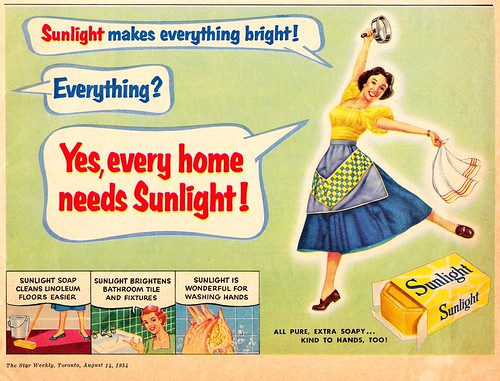
The image most of us have as a post-war woman is that of a housewife—the woman perpetually wearing a dress, entranced by new home appliances, and playing a supporting role to the husband on TV shows like Leave it to Beaver and Father Knows Best. Today, can you imagine a world in which:
  • Women accounted for only 6% of American doctors, 3% of lawyers, and less than 1% of engineers?
  • Wives' names were not even included on a house deed and a woman could not lease an apartment unless it was co-signed by a man?
  • Women were banned from certain executive flights, bars, golf courses, and lunch counters because it was believed "men needed faster service than women because they have important business to do?"
  • A man made twice as much at the same job as a woman because men "had families to support?"
  • (and the clincher...) A woman was thrown out of traffic court for wearing a pair of slacks?

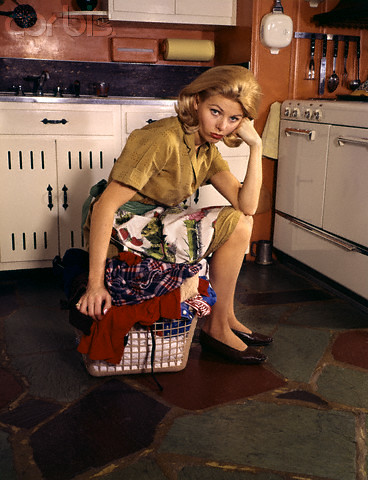
Easily Excited Housewife

That's pretty much how things were in 1960. Women's assumed place was in the home and, if they did choose to work, it was in a career traditionally occupied by women: teacher/nurse/secretary. But during WWII, if you recall, women joined the workforce while the men were off at war. Rosie the Riveter gave women power! So what happened to that power between 1945 and 1960?

In short, economics. After the war, everyone just wanted everything to return to normal, which included women leaving the workforce and returning home. And because of the huge post-war economic boom and an unprecedented standard of living, many families could survive and prosper with only one source of income. Though just as many women were still working in 1960 as had been during the peak of WWII, it was assumed to be better if the woman could stay at home where her only duties were domestic. Society's standards had not yet seemed to catch up to a reality where women worked outside the home, and most young women, despite having working mothers, assumed they would still be stay-at-home.

42-20040347The opening line of chapter two states, "The previous chapter made American women circa 1960 sound very badly treated. But at the time, most of them would not have seen things that way." Its much easier to put yourself in another's position retrospectively, but you have to understand that viewpoints were very different while it was happening; I'm sure many women never considered anything wrong with their way of life. And this is where Collins' research fascinates me. She traces the changing mentality of both women and society as a whole as the nation prepared for a sudden explosion of women's liberation. Why did women suddenly fight for equality and rebel against tradition? Collins slowly dissects the mentality of all sorts of women—urban, suburban, rural, white, black, educated, uneducated, middle-class, lower-class. We see through the examples of individuals how women were educated side-by-side the men in university, but then filtered into gender-appropriate careers and expected to quit once they walked down the aisle. But as Betty Frieden posed in her famous discourse The Feminine Mystique, once the kids had flown the nest, what was left for the mother to do?

I love the style of this book—short sections within each chapter that focus on one anecdote or piece of evidence. It breaks up what could otherwise be a very heavy, boring narrative full of facts and figures (and it's perfect for public transportation reading!). It's inspiring me to Google search all the people and places that Collins briefly mentions for more information. I am urging my mom to read this and discuss with me, since she was a young woman in the 1960s—the key generation affected by the women's liberation movement; I think her first-hand account would be fascinating.

I promise (maybe) that my commentary on Part Two won't be such a history lesson, but this background was just fascinating to me. It's particularly interesting to hear the everyday stories and understand how several factors and a general feeling of discontent quickly led to such a poignant revolution.


Just a heads up, a review copy was provided to me by the publisher.

Saturday, May 22, 2010

Review: The Old Man and Me

| 7 comments:
There were two reasons Elaine Dundy's The Old Man and Me immediately appealed to me. One, it's an NYRB Classic, and I totally dig that publisher. Two, I totally dug the cover. And I'm not gonna lie, the cover was really the main reason.

Also, the premise didn't sound too bad.

"Honey Flood" (and by using quotes, I am hinting that is not her real name) is a young American woman living in London in the early sixties—before the Beatles and the Stones and before London was the exciting tourist destination it is now. You initially think Honey is just a broke ex-Pat living an adventure overseas, but Dundy slowly reveals that Honey is on a mission. She's lost her inheritance after a chain of marriages and deaths, and she's aiming to get it back from a middle-aged English intellectual named C.D. McKee. And if his death is the only way she can get her money...well then Honey will just do what she has to do.

Let me tell you...Dundy is a witty writer. Some of the scenarios are far-fetched enough to illicit a a cry of, "She's a loon!" but the humor instilled into the writing serves as a balance. Crazy or not, Honey still captures the curiosity of the reader with her quick wit and unorthodox behavior. She's very much the modern woman with a lifestyle that very much contrasts the proper, high-class one of C.D. And that's not the only contrast found in the plot...

Also infused in the narrative is the culture clash between America and Britain during a time when one enjoyed enormous post-war prosperity and the other struggled to regain power. This dynamic backdrop bumps the novel up a few notches in terms of cultural awareness and sets the scene perfectly well. Dundy did an excellent job of creating a bohemian tone in a time and place that wouldn't typically be considered "bohemian." I think the interesting setting was the most satisfying aspect of the novel for me. I really wanted to hop back in time and experience post-war London while reading this.

The Old Man and Me didn't quite live up to my somewhat unreasonably high expectations (that's the problem with judging books by the covers, right?), but it was fun and did not disappoint. It deserves a second reading. I'm anxious to read her other famous novel, The Dud Avocado—another NYRB title, which takes place in Paris in the fifties.


This review is part of the Spotlight Series tour for NYRB Classics. Today is the last day of the tour, so be sure to check the list and discover all the other wonderful titles that have already been reviewed!

Friday, May 21, 2010

The Obligatory BEA Week Planning Post

| 3 comments:
I'm just gonna hop on the bandwagon and throw a quick note out there about next week's exciting book adventures in the Big Apple. It's BEA and Book Blogger Con...yayyyy!

As a resident New Yorker, I haven't been anticipating next week as a major event since I don't have to go anywhere or really plan anything...and I also still have to work all next week, limiting my time at BEA (one, I thankfully work for a company that has a booth and I will get to attend at some point during the day; two, never fear, I did take a personal day for BBCon). Also, my attendance at the BBCon reception is completely dependent on if I happen to already be at the Javits Center during BEA hours on Thursday. However, there are still lots of fun activities outside of my working hours and beyond official BEA events that I will be attending.

The two big ones:
  • HarperCollins' Celebration of Book Bloggers at the Algonquin Hotel on Wednesday night (the 26th), 7—9 pm.
  • Goodreads' New York City Literary Pub Crawl on Thursday night (the 27th), starting at 7pm. This one starts at Housing Works Bookstore in Soho with a cocktail hour and readings by Amy King, Colson Whitehead, and Emily St. John Mandel; then heads on to Botanica, Tom & Jerry's, and KGB Bar. Can't make any promises as to how far I'll crawl, but I'm aiming for at least half.
For some excellent compilations of signings, conferences, events at BEA, check out the lists Jen has posted at Devourer of Books.


I'd love to meet as many fellow booknerds as I can, so feel free to leave a comment or shoot me an email and I'll keep my eye out for you! And if you have a hankering to explore the rest of the city and have questions about anything NYC related, please ask!

Wednesday, May 19, 2010

Wordless Wednesday: 2 Years Ago..

| 6 comments:
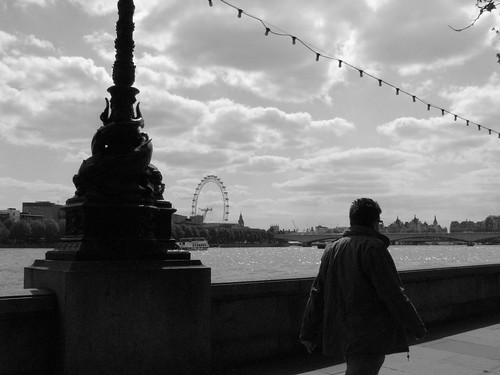
My post-graduation European vacation had just begun. Now I sit at a desk in front of a computer everyday. Yay to growing up!

Thames


For more Wordless Wednesday, go here.

Tuesday, May 18, 2010

NEW BOOK! Review: When bad guys go good

| 3 comments:
I told you a review of Emily St. John Mandel's The Singer's Gun was coming...wait no more!

Anton Waker has always been surrounded by shady business. He grew up with parents that made a living off selling stolen goods; his cousin Aria trained him to shoplift at an early age; and eventually, Aria led Anton down his own path of illegal business—selling fake passports and social security cards. They've forged a successful business—and Anton calls it the easier job he's ever had—but for the past several years, Anton has distanced himself from the illegal business market and built a life he doesn't have to lie about, complete with office job, apartment, and fiancĂ©e.

All of that comes to a crashing halt when Aria blackmails Anton into helping her with one last transaction—one that ends up jeopardizing the lifestyle he's worked hard to attain and leaves him on the island of Ischia for months...just waiting to complete the transaction so he can move on with his life.

When I went to the book's launch party a couple weeks ago, the author described her novels as "contemporary noir" and that is a very good description that I hadn't even considered. The whole tone of The Singer's Gun is a little bit mysterious and a little bit dark as the story slowly and carefully unfolds. (To give you an idea of the tone, the voice reading this in my head was that of a detective from 1940s noir, with his feet on the desk, a drink in hand, and a cigarette lisp.) You always get the feeling that there is some little unknown detail that would make everything fall into place, and it's satisfying when these details are gradually revealed. Anton is a likable character and complex enough to keep you wanting to know what decisions he'll make and how it will all end. A supporting cast with depth contributes to the draw, though upon finishing the book, I was a little disappointed that the story of some characters had no real conclusion.

One thing is very clear: Mandel writes with layers. She seamlessly (and seemingly effortlessly!) jumps back and forth in time to reveal details of the story's full context. It's an intelligent, well-crafted thriller with characters that are complex enough to hook the reader.


Review copy provided by the publisher (Unbridled Books).