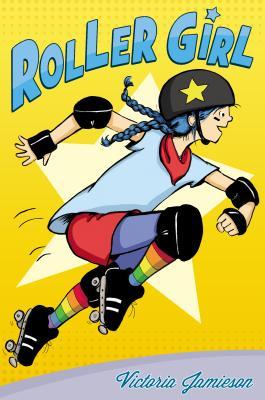
As I mentioned a couple posts ago, my middle schoolers love graphic novels, and truth be told, they got me wanting to read many of them! Once last school year ended, I had a list of titles I wanted to read on my own over break, and that's just what I did at the start of summer. Raina Telgemeier's books were on that list, as well as these three:
Roller Girl by Victoria Jamieson came out towards the end of last year, and I rarely saw it returned long enough to actually be shelved. In it, twelve-year-old Astrid Vasquez has hit that awkward point where you suddenly seem to no longer click with your life-long best friend. Astrid has done everything with Nicole since early elementary school, including suffering through Ms. Vasquez's Evenings of Cultural Enlightenment (ECEs for short, and a small detail of this story I absolutely love), the most recent of which was a roller derby match. Astrid becomes enchanted with this sport, and assumes Nicole will be right beside her at the roller derby camp Ms. Vasquez suggests attending, but now Nicole is more into ballet and is actually friendly with their one-time sworn enemy, Rachel.
Astrid masks her hurt with a little bit of anger and extra determination, attending the camp on her own. It's hard, and she fails miserably at first, but Astrid is the kind of girl that is fueled by those failures; she's no quitter. She's realistically bratty but is also tough and resilient, which are good character traits I don't find as often in realistic middle grade fiction. This is a great story that touches on a very common part of adolescence and adolescent friendships—that people and relationships often change, and that a great deal can be learned by leaving our comfort zones.
The Jellaby series by Kean Soo has absolutely the most adorable artwork of all the graphic novels on my shelves. In the self-titled series opener, Portia has just moved into a new neighborhood and school where she doesn't really fit in. She's quiet and keeps to herself; no one makes an effort to befriend her. And at home, her father is suddenly absent, and she's adjusting to life without him. One late night, she takes a walk in the nearby woods and is followed home by a shy, gentle purple monster she names Jellaby. Life becomes much more exciting, knowing she is the sole keeper of this great secret. She also unintentionally befriends another equally shy boy named Jason, and together they begin a quest to find out where Jellaby belongs.
The story continues with Jellaby: Monster in the City, when the quest to find Jellaby's home takes the three on the train into the city. As they follow the clues, it starts to appear as though there's a rather sinister background to Jellaby's story...and somehow, Portia's dad may be involved!
These stories fall a bit into the magical realism realm. There are no identifying places or references to really ground them in a particular time or place; they exist in an entirely generic world. And truthfully, as an adult, I think they may depend on a greater degree of childhood imagination/suspension-of-belief than I possess. Each book contains such a SNIPPET of story that it's going to take several more volumes before it actually feels complete and satisfying (my same complaint with the Incorrigible Children of Ashton Place series). Though I loved the artwork, the story itself left me a bit clueless as to the point or where it is going.
Showing posts with label graphic novel. Show all posts
Thursday, September 3, 2015
Tuesday, August 25, 2015
Reading Roundup: The Raina Telgemeier Collection
The kids at my school love graphic novels. I mean love. Our graphic novel collection was pretty sparse when I entered the school last year, and I spent a good chuck of money buying any graphic novel that seemed appropriate for middle school aged kids—anything and everything just to fill those shelves. What I found was that when the kids find one they like, they want 17 more just like it. It was the series the were incredibly popular, and those award-winning standalone books notable in the adult/librarian community, like Anya's Ghost and American Born Chinese, did not get nearly the same attention as action/fantasy series like Maximum Ride, Bone, Amulet, Artemis Fowl, Zita the Spacegirl,
The Elsewhere Chronicles...I could go on.
The exception I found was with Raina Telgemeier's three titles: Smile, Sisters, and Drama. These three stories, though each a standalone in terms of story, are so similar in style that kids view them as a set--and chances are if they like one, they will like the others.
In a genre/style that seems to have few stories based in true middle school reality, Telgemeier fills this much needed gap in the graphic novel genre. These are stories to which girls can relate with everyday problems and dramas, same as they would enjoy other realistic series like Dork Diaries or Dear Dumb Diary. The plots are simple; the interactions are common; the humor is level-appropriate; and the art is colorful and appealing. One of my proudest moment last year was watching an 8th grade girl, the only student in her class to not read a single book during our month-long reading incentive program, sit and read Sisters in one sitting then tell me all about it.
I think these are great books to grab a reluctant female reader, especially the older ones, to prove that reading doesn't always have to be a long-winded chapter book; it can be light and enjoyable, and Telgemeier's books are a great entryway into a new format of story they may find they love.
The exception I found was with Raina Telgemeier's three titles: Smile, Sisters, and Drama. These three stories, though each a standalone in terms of story, are so similar in style that kids view them as a set--and chances are if they like one, they will like the others.
- Telgemeier's first published graphic novel, Smile, is a memoir of her own awkward middle school years when an injury to her two front teeth leaves her dealing with an excessive amount of painful, annoying dentistry for most of her adolescent years—as if being 13 wasn't hard enough!
- Drama tells the story of theater tech nerd Callie, who has always preferred being on stage crew to being center stage. It's the story of a girl who blossoms in a typically-outsider group, a reminder that everyone can find their own place and community.
- In the recently-published Sisters, the author returns to her own life to chronicle the seemingly-never-ending conflict between herself and her sister, Amara. They're totally opposite and never get along, but knowing they are sisters, after all, they know they're going to have to make it work.
In a genre/style that seems to have few stories based in true middle school reality, Telgemeier fills this much needed gap in the graphic novel genre. These are stories to which girls can relate with everyday problems and dramas, same as they would enjoy other realistic series like Dork Diaries or Dear Dumb Diary. The plots are simple; the interactions are common; the humor is level-appropriate; and the art is colorful and appealing. One of my proudest moment last year was watching an 8th grade girl, the only student in her class to not read a single book during our month-long reading incentive program, sit and read Sisters in one sitting then tell me all about it.
I think these are great books to grab a reluctant female reader, especially the older ones, to prove that reading doesn't always have to be a long-winded chapter book; it can be light and enjoyable, and Telgemeier's books are a great entryway into a new format of story they may find they love.
Tuesday, July 21, 2015
Nonfiction | Agonizing Over Adulthood
In case you haven't noticed, my year has been filled with a lot of middle grade reading—fiction, nonfiction, graphic novels, anything. When the next on my reading challenge list was a graphic novel, any graphic novel, it would've been easy to just pick up one of the gazillion young titles on my library shelves, but I thought this would be a good opportunity to enjoy a graphic story from a more adult voice.
The book I chose is Drinking at the Movies by Julia Wertz. She's the creator of The Fart Party, which the back of the book tells me is a cult-hit comic. Drinking at the Movies is her first full-length memoir, which chronicles the year she left her home in San Francisco and moved to New York.
There are a lot of such stories out there. Twenty-somethings move to the big city for an experience, or some kind of personal test, and it's so unlike any other experience that they, of course, document it. So there's that kind of story—first adventures/disasters/disillusions with New York City. Then there's the stories of just 20-somethings themselves—lost in life, often trying to find themselves by losing a familiar geographic sense of comfort. I guess you could consider Drinking at the Movies both of these things, but Wertz doesn't strike me as a narrator that a) takes herself too seriously, b) takes what she says too seriously, and c) ponders these experiences as big, serious life-defining moments.
In a sense, her attitude was very refreshing. In another sense, her attitude reeked of a lackadaisical "I can screw up because I'm 24, so I won't worry about my choices." Like most folks of her age and situation, Wertz drinks too much; she doesn't feel like an adult and scoffs at the idea with humor, rather than trying to evolve into it; she doesn't think of her future in a serious sort of way—it's more an immediate future worrying, not long-term thinking. It's unclear whether New York was her long-term plan or just a whim, but it was her first important step towards a more grown-up future. There are so many similar stories of people around this age doing just this, because this step outside of one's comfort zone is so developmentally significant, and can be equally as life-affirming.
Regardless of whether it's a new story or one told a thousand times before, I thought Wertz was hilarious. The structure of this book is very much short, anecdotal comics thrown together to tell a complete story. In that sense, it's a great one to read in brief spurts, though I read it basically in one sitting. She's self-critical while avoiding the self-critique that requires loads of self-reflection. Whether she's telling stories of encounters with the homeless, the days she's lost jobs, the excessive amount of junk she eats, or her drug-addicted brother's bouts in and out of rehab, Wertz writes about her life with a "HERE IT IS" attitude—and she does it with such wit that you figure she must be that great kind of sardonic storyteller in real life. Or at least that friend you can count on for a great one-liner, said under her breath, at the best moment of any situation.
The book I chose is Drinking at the Movies by Julia Wertz. She's the creator of The Fart Party, which the back of the book tells me is a cult-hit comic. Drinking at the Movies is her first full-length memoir, which chronicles the year she left her home in San Francisco and moved to New York.
There are a lot of such stories out there. Twenty-somethings move to the big city for an experience, or some kind of personal test, and it's so unlike any other experience that they, of course, document it. So there's that kind of story—first adventures/disasters/disillusions with New York City. Then there's the stories of just 20-somethings themselves—lost in life, often trying to find themselves by losing a familiar geographic sense of comfort. I guess you could consider Drinking at the Movies both of these things, but Wertz doesn't strike me as a narrator that a) takes herself too seriously, b) takes what she says too seriously, and c) ponders these experiences as big, serious life-defining moments.
In a sense, her attitude was very refreshing. In another sense, her attitude reeked of a lackadaisical "I can screw up because I'm 24, so I won't worry about my choices." Like most folks of her age and situation, Wertz drinks too much; she doesn't feel like an adult and scoffs at the idea with humor, rather than trying to evolve into it; she doesn't think of her future in a serious sort of way—it's more an immediate future worrying, not long-term thinking. It's unclear whether New York was her long-term plan or just a whim, but it was her first important step towards a more grown-up future. There are so many similar stories of people around this age doing just this, because this step outside of one's comfort zone is so developmentally significant, and can be equally as life-affirming.
Regardless of whether it's a new story or one told a thousand times before, I thought Wertz was hilarious. The structure of this book is very much short, anecdotal comics thrown together to tell a complete story. In that sense, it's a great one to read in brief spurts, though I read it basically in one sitting. She's self-critical while avoiding the self-critique that requires loads of self-reflection. Whether she's telling stories of encounters with the homeless, the days she's lost jobs, the excessive amount of junk she eats, or her drug-addicted brother's bouts in and out of rehab, Wertz writes about her life with a "HERE IT IS" attitude—and she does it with such wit that you figure she must be that great kind of sardonic storyteller in real life. Or at least that friend you can count on for a great one-liner, said under her breath, at the best moment of any situation.
Wednesday, June 24, 2015
Speed Dating with Middle Grade: Part 6
Despite their wildly different format, these three books from our city-wide Battle of the Books list each tell the story of boys who are growing up, gaining a better understanding of themselves and the world around them. Potentially enjoyed by all, but especially geared towards a male audience!
Title: The Dumbest Idea Ever
Author: Jimmy Gownley
Genre: Graphic Novel, Memoir
Read If You Like...: A flawed protagonist, underdog stories, and realistic boy humor
Three-Sentence Thoughts: Thirteen-year-old Jimmy is rockin' middle school until a bout of the chicken pox and pneumonia forces him to miss his championship basketball game. Everything—his academic and social life—goes in a downward spiral after that, but a burgeoning love of comic books may be just the thing that saves him from teenage disaster. This humorous story of how Jimmy went from basketball star to comic book artist will especially appeal to boys.
Title: The Madman of Piney Woods
Author: Christopher Paul Curtis
Genre: Historical Fiction
Read If You Like...: Adventure tales, unlikely duos, and heartfelt friendships
Three-Sentence Thoughts: A chance encounter between Benji and Red, two exceedingly different boys, leads to an adventure neither of them could have expected. The two are on a mission to discover the true story behind the "Madman of Piney Woods," but the real story is in their growing friendship despite very different lives. This story is a good reminder of the various issues that have affected different groups of people throughout history and how people are often more similar than different.
Title: The Crossover
Author: Kwame Alexander
Genre: Sports (Realistic), Poetry
Read If You Like...: Stories about siblings, competitive sports, and the magic of words
Three-Sentence Thoughts: Josh and Jordan are twins that have always been a duo on the court and off, but Josh is starting to notice that things are changing...and he may not be ready for it. Jordan is chasing girls and crushing it on the court, and Josh is just trying to deal with feeling like second fiddle. Beautifully told through a creative verse format, The Crossover broaches significant subject matter with considerable style—highly appealing to the most reluctant of boy readers.
Title: The Dumbest Idea EverAuthor: Jimmy Gownley
Genre: Graphic Novel, Memoir
Read If You Like...: A flawed protagonist, underdog stories, and realistic boy humor
Three-Sentence Thoughts: Thirteen-year-old Jimmy is rockin' middle school until a bout of the chicken pox and pneumonia forces him to miss his championship basketball game. Everything—his academic and social life—goes in a downward spiral after that, but a burgeoning love of comic books may be just the thing that saves him from teenage disaster. This humorous story of how Jimmy went from basketball star to comic book artist will especially appeal to boys.
Title: The Madman of Piney WoodsAuthor: Christopher Paul Curtis
Genre: Historical Fiction
Read If You Like...: Adventure tales, unlikely duos, and heartfelt friendships
Three-Sentence Thoughts: A chance encounter between Benji and Red, two exceedingly different boys, leads to an adventure neither of them could have expected. The two are on a mission to discover the true story behind the "Madman of Piney Woods," but the real story is in their growing friendship despite very different lives. This story is a good reminder of the various issues that have affected different groups of people throughout history and how people are often more similar than different.
Title: The CrossoverAuthor: Kwame Alexander
Genre: Sports (Realistic), Poetry
Read If You Like...: Stories about siblings, competitive sports, and the magic of words
Three-Sentence Thoughts: Josh and Jordan are twins that have always been a duo on the court and off, but Josh is starting to notice that things are changing...and he may not be ready for it. Jordan is chasing girls and crushing it on the court, and Josh is just trying to deal with feeling like second fiddle. Beautifully told through a creative verse format, The Crossover broaches significant subject matter with considerable style—highly appealing to the most reluctant of boy readers.
Wednesday, April 15, 2015
Reading Roundup: Youthful Nostalgia, Part 2
As I started brainstorming for a title for this post, I was struck by a sneaking suspicion that I had already typed the words I found myself typing. Turns out, about a year ago I reviewed two graphic novels that fall very closely in line with the two I am about to share now. (Hence "Youthful Nostalgia, Part 2!") They are both stories told with the wisdom of adulthood as the authors recall prior experiences and share their memories with limited prose and through carefully crafted illustrations. You could say they're told with a sense of nostalgia, but they're mostly a reflection, on the author's part, of impactful youthful experiences.
In Mariko and Jillian Tamaki's This One Summer, Rose is spending the summer with her parents in the same rural beach town they've visited every year. It's the kind of setting where kids are left free to roam and have typical "kid" adventures, while the parents get a break to relax and maybe do some work away from their normal work environment. For Rose, life picks up where it left off the previous summer. She reunites with her summer best friend Windy, and they navigate adolescence in a sort of suspended existence; they are the ones that change year to year as the world around them stays the same.
The Tamakis tell this quiet story of two girls on the cusp of the teenage years, the ones where they start to notice all the "adult world" things that exist, and have always existed, around them. It's subtley beautiful and perfectly captures the in-between years...but it's by no means pleasant. I found Rose to be at that annoyingly, precociously negative phase where she's just insufferable and needs a good kick in the pants. But to her defense, she is bombarded with these very real, serious situations—like marital issues, miscarriages, unwanted pregnancies, and slut-shaming—that bog down any remaining childhood carefree naivety as she starts to understand what they all mean. I still can't completely decide if I really enjoyed the story, but at least I understand that maybe I wasn't supposed to. The art, though, is phenomenal.
I ordered this book for my middle school library after reading a lot of YA buzz about it, as I'm trying to find materials a little more mature for my younger-skewed collection. After reading, I decided it's definitely not going on my normal library shelves. (I made it a "back-shelf" book that I've given to a couple of mature 8th graders...and even they were a little thrown by the mature language and subject-matter.) Though the characters are middle schoolers, this story is more of a poignant remembrance on your first encounters with situations you know are way too old for you...and my students are not in that reflective stage yet. It's hard to remember life with a sheltered perspective once that shelter is gone. An older teen might "get it," but I also have to think of those sheltered 5th graders; and thinking about a 10-year-old picking this up and reading it with a parent makes me squirm.
I've said before that Lucy Knisley's graphic memoirs are ones I surprisingly really enjoy. Her most recent travelogue/journal, An Age of License, is no exception.
When Lucy is invited to speak at a comic convention in Norway, she decides to turn her hop across the pond into an adventure that takes her further afield to Sweden, Germany, and France. Having gone through a recent breakup, she grabs onto that mid-twenties bohemian moment where the "Why not?" commitment-free mindset leads to unexpected places and relationships. She once heard it called L'Age License, which basically means a "license to experience, mess up, license to fail, license to do...whatever, before you're settled." The phrase may or may not actually exist, but Lucy's own Age of License leads her to a new romance in Sweden, a reunion with friends in Germany, and a country respite with family in France.
According to my own recent statements on memoirs, I don't enjoy memoirs that have no extraordinary experience to share. And to be honest, backpacking through Europe in your twenties is more like a right of passage at this point than an utterly unique experience. And also, the mid-twenties angst of uncertainty is mind-numbingly over-represented. What makes Knisley an exception to my rule, though, is the way in which she tells her stories—I adore her illustrations. Her drawings, to me, add so much to the experiences she's sharing. The details create an ambiance of blissful memory that make us feel like we're being included in a private, special moment of the author's. We all have memories like that, where the details are seared into our brain; they're what make our own experiences unique to us even if they're completely ordinary to someone else. I think that's why I care more with Knisley. She doesn't just tell a story; she shows us what made it special.
In Mariko and Jillian Tamaki's This One Summer, Rose is spending the summer with her parents in the same rural beach town they've visited every year. It's the kind of setting where kids are left free to roam and have typical "kid" adventures, while the parents get a break to relax and maybe do some work away from their normal work environment. For Rose, life picks up where it left off the previous summer. She reunites with her summer best friend Windy, and they navigate adolescence in a sort of suspended existence; they are the ones that change year to year as the world around them stays the same.
The Tamakis tell this quiet story of two girls on the cusp of the teenage years, the ones where they start to notice all the "adult world" things that exist, and have always existed, around them. It's subtley beautiful and perfectly captures the in-between years...but it's by no means pleasant. I found Rose to be at that annoyingly, precociously negative phase where she's just insufferable and needs a good kick in the pants. But to her defense, she is bombarded with these very real, serious situations—like marital issues, miscarriages, unwanted pregnancies, and slut-shaming—that bog down any remaining childhood carefree naivety as she starts to understand what they all mean. I still can't completely decide if I really enjoyed the story, but at least I understand that maybe I wasn't supposed to. The art, though, is phenomenal.
I ordered this book for my middle school library after reading a lot of YA buzz about it, as I'm trying to find materials a little more mature for my younger-skewed collection. After reading, I decided it's definitely not going on my normal library shelves. (I made it a "back-shelf" book that I've given to a couple of mature 8th graders...and even they were a little thrown by the mature language and subject-matter.) Though the characters are middle schoolers, this story is more of a poignant remembrance on your first encounters with situations you know are way too old for you...and my students are not in that reflective stage yet. It's hard to remember life with a sheltered perspective once that shelter is gone. An older teen might "get it," but I also have to think of those sheltered 5th graders; and thinking about a 10-year-old picking this up and reading it with a parent makes me squirm.
*****************
I've said before that Lucy Knisley's graphic memoirs are ones I surprisingly really enjoy. Her most recent travelogue/journal, An Age of License, is no exception.
When Lucy is invited to speak at a comic convention in Norway, she decides to turn her hop across the pond into an adventure that takes her further afield to Sweden, Germany, and France. Having gone through a recent breakup, she grabs onto that mid-twenties bohemian moment where the "Why not?" commitment-free mindset leads to unexpected places and relationships. She once heard it called L'Age License, which basically means a "license to experience, mess up, license to fail, license to do...whatever, before you're settled." The phrase may or may not actually exist, but Lucy's own Age of License leads her to a new romance in Sweden, a reunion with friends in Germany, and a country respite with family in France.
According to my own recent statements on memoirs, I don't enjoy memoirs that have no extraordinary experience to share. And to be honest, backpacking through Europe in your twenties is more like a right of passage at this point than an utterly unique experience. And also, the mid-twenties angst of uncertainty is mind-numbingly over-represented. What makes Knisley an exception to my rule, though, is the way in which she tells her stories—I adore her illustrations. Her drawings, to me, add so much to the experiences she's sharing. The details create an ambiance of blissful memory that make us feel like we're being included in a private, special moment of the author's. We all have memories like that, where the details are seared into our brain; they're what make our own experiences unique to us even if they're completely ordinary to someone else. I think that's why I care more with Knisley. She doesn't just tell a story; she shows us what made it special.
Thursday, January 29, 2015
Speed Dating with Middle Grade: Part 3
Here's my last round of middle grade speed dating for a bit; I've played catch-up, and it's about time to get back into the adult world of literature! If last round's three titles seemed similar, this round's are everything but!
It's been interesting to see how my own opinions on certain books have changed as I consider a new perspective—that of an 11- or 12-year-old. The hardest thing to realize is that your personal adolescence is by no means representative of Adolescence. Every kid is in a different place with different emotions, different interests, and different experiences. That makes the job both motivating and disappointing as you introduce your students to new things. I can understand how long-time librarians have a tough time weeding their collection that they so meticulously curated; if you love something, you want your readers to love it too, and sometimes that just doesn't happen! [The number of check-outs on our new, hand-picked-by-me DVD copy of Harriet the Spy is just disappointingly low.]
Title: I Am Malala: How One Girl Stood Up for Education and Changed the World (Young Readers edition)
Author: Malala Yousafzai
Genre: Memoir
Read If You Like...: True stories, inspiring figures, and world politics
Three-Sentence Thoughts: Malala Yousafzai is a figure that should be a household name—she is the youngest-ever winner of the Nobel Prize for her work in human rights advocacy and women's education, after all. Here, she tells her story as she saw her home country of Pakistan change with Taliban rule in the early 2000s, as she defied their ban on education for women, and as she survived a gunshot to the head from an attempt on her life by a Taliban soldier. Malala's story is an exceptionally moving and inspiring one that young readers should encounter, but it's also a frightening one as you realize exactly how easily the freedoms we take for granted can disappear and (for adult readers) how this moment in history happened in our lifetime right under our noses.
Title: Gone Away Lake
Author: Elizabeth Enright
Genre: Classic, Adventure
Read If You Like...: Summer stories, nostalgia, and quaint adventures
Three-Sentence Thoughts: It's summer vacation and cousins Portia and Julian find an adventure when they discover a ghost town in the woods where remnants include decadent old houses, long-forgotten antiques...and two of the town's former residents still living in their deserted home! The jacket flap blurb led me to believe this was going to be much more of an adventure-mystery than it actually was, as the actual plot was pretty dated and not very exciting. Nostalgic adults may delight in this old-fashioned adventure, but now, with my middle school librarian perspective, all I could think was how my kids would be bored out of their minds with this.
Title: Cleopatra in Space: Target Practice
Author: Mike Maihack
Genre: Graphic novel, Fantasy
Read If You Like...: Historical figures, time travel, and Zenon: Girl of the 21st Century [anyone? anyone??]
Three-Sentence Thoughts: In this time-traveling adventure, a young Cleopatra finds a mysterious tablet that zaps her from ancient Egypt to the far, far future where she learns of a prophecy that she will save the galaxy from an evil ruler. She enrolls in school with a typical course-load of math, biology, and combat training and is put to the test to find out if she does, in fact, have the potential to be a hero. I breezed through this one, and it's fun but will definitely be more satisfying as the rest of the series is written and released.
It's been interesting to see how my own opinions on certain books have changed as I consider a new perspective—that of an 11- or 12-year-old. The hardest thing to realize is that your personal adolescence is by no means representative of Adolescence. Every kid is in a different place with different emotions, different interests, and different experiences. That makes the job both motivating and disappointing as you introduce your students to new things. I can understand how long-time librarians have a tough time weeding their collection that they so meticulously curated; if you love something, you want your readers to love it too, and sometimes that just doesn't happen! [The number of check-outs on our new, hand-picked-by-me DVD copy of Harriet the Spy is just disappointingly low.]
Title: I Am Malala: How One Girl Stood Up for Education and Changed the World (Young Readers edition)
Author: Malala Yousafzai
Genre: Memoir
Read If You Like...: True stories, inspiring figures, and world politics
Three-Sentence Thoughts: Malala Yousafzai is a figure that should be a household name—she is the youngest-ever winner of the Nobel Prize for her work in human rights advocacy and women's education, after all. Here, she tells her story as she saw her home country of Pakistan change with Taliban rule in the early 2000s, as she defied their ban on education for women, and as she survived a gunshot to the head from an attempt on her life by a Taliban soldier. Malala's story is an exceptionally moving and inspiring one that young readers should encounter, but it's also a frightening one as you realize exactly how easily the freedoms we take for granted can disappear and (for adult readers) how this moment in history happened in our lifetime right under our noses.
Title: Gone Away Lake
Author: Elizabeth Enright
Genre: Classic, Adventure
Read If You Like...: Summer stories, nostalgia, and quaint adventures
Three-Sentence Thoughts: It's summer vacation and cousins Portia and Julian find an adventure when they discover a ghost town in the woods where remnants include decadent old houses, long-forgotten antiques...and two of the town's former residents still living in their deserted home! The jacket flap blurb led me to believe this was going to be much more of an adventure-mystery than it actually was, as the actual plot was pretty dated and not very exciting. Nostalgic adults may delight in this old-fashioned adventure, but now, with my middle school librarian perspective, all I could think was how my kids would be bored out of their minds with this.
Title: Cleopatra in Space: Target Practice
Author: Mike Maihack
Genre: Graphic novel, Fantasy
Read If You Like...: Historical figures, time travel, and Zenon: Girl of the 21st Century [anyone? anyone??]
Three-Sentence Thoughts: In this time-traveling adventure, a young Cleopatra finds a mysterious tablet that zaps her from ancient Egypt to the far, far future where she learns of a prophecy that she will save the galaxy from an evil ruler. She enrolls in school with a typical course-load of math, biology, and combat training and is put to the test to find out if she does, in fact, have the potential to be a hero. I breezed through this one, and it's fun but will definitely be more satisfying as the rest of the series is written and released.
Wednesday, January 21, 2015
Speed Dating with Middle Grade: Part 1
At some point (semi-)recently, I noted the irony in being a librarian but never having time to read, and as I mentioned in my year-end summary, that's not entirely true. I have been reading, some. Mostly I've binged on middle grade books over breaks—Fall Break, Thanksgiving Break, Winter Break.
Because one of my two reading goals for the year was to simply post about it, I'm going to do a speed dating-style summary of allllllll that I've read over the past semester. These books have been so enjoyable with a busy schedule, because they're just so wonderfully non-complex—that's the draw of the middle grade genre. Real things can happen, but it's not quite so realistically dramatic and complicated; there's still a titch of innocence there. I frequently just grab books off my shelves and check them out to myself, because I'm dying for that carefree fun!
I've covered quite an array of styles and genres in the recent past. Hopefully something here will entice you!
Title: Liar & Spy
Author: Rebecca Stead
Genre: Realistic, Mystery
Read If You Like...: Quirky stories, sympathetic characters, and poignant, nostalgic self-reflection
Three-Sentence Thoughts: Georges considers himself the lone odd duck in his 7th grade class, until he meets Safer, a coffee-drinking self-proclaimed spy who recruits Georges as another spy in their Brooklyn apartment building. Georges' main struggle, though, is figuring out what's real and what's a lie and if trust is something worth giving. I loved reading Georges' internal musings, because the poignancy of this thoughts trigger that initial entry into the adult world.
Sidenote: This book also has a pretty good message about bullying and how kids can take their own kind of (non-violent) action. I've recommended it to some kids at my school to inspire their own anti-bullying support group.
Title: Buzz!
Author: Ananth Panagariya, Tessa Stone
Genre: Graphic Novel, (somewhat) Fantasy
Read If You Like...: A unique concept, academic humor, and Scott Pilgrim
Three-Sentence Thoughts: This is a world where the spelling bee rules, and our hero Webster has just gotten drawn into the illegal underground spelling bee circuit. Webster is put to the test as he skirts the law and faces the intimidating "big bads" of the competitive bee crowd. The most fun part of this book is the excellent, action-packed art, but I found the story's perspective a little too narrow to really grasp my attention and intrigue and the dialogue to be rather flat.
Title: Mockingbird
Author: Kathryn Erskine
Genre: Realistic
Read If You Like...: Books told through alternating perspectives, serious issues, and affecting stories
Three-Sentence Thoughts: Caitlin is an eleven-year-old with autism having a hard time navigating life without her brother since he was killed in a school shooting. Most often told through Caitlin's perspective, Mockingbird shares her journey of making it through each day as she struggles to understand emotions in situations so strongly affected by it. This is an incredibly moving story that serves a great role in reminding middle schoolers of the importance of perspective and situation while appealing to their growing desire for emotional stories.
Because one of my two reading goals for the year was to simply post about it, I'm going to do a speed dating-style summary of allllllll that I've read over the past semester. These books have been so enjoyable with a busy schedule, because they're just so wonderfully non-complex—that's the draw of the middle grade genre. Real things can happen, but it's not quite so realistically dramatic and complicated; there's still a titch of innocence there. I frequently just grab books off my shelves and check them out to myself, because I'm dying for that carefree fun!
I've covered quite an array of styles and genres in the recent past. Hopefully something here will entice you!
Title: Liar & Spy
Author: Rebecca Stead
Genre: Realistic, Mystery
Read If You Like...: Quirky stories, sympathetic characters, and poignant, nostalgic self-reflection
Three-Sentence Thoughts: Georges considers himself the lone odd duck in his 7th grade class, until he meets Safer, a coffee-drinking self-proclaimed spy who recruits Georges as another spy in their Brooklyn apartment building. Georges' main struggle, though, is figuring out what's real and what's a lie and if trust is something worth giving. I loved reading Georges' internal musings, because the poignancy of this thoughts trigger that initial entry into the adult world.
Sidenote: This book also has a pretty good message about bullying and how kids can take their own kind of (non-violent) action. I've recommended it to some kids at my school to inspire their own anti-bullying support group.
Title: Buzz!
Author: Ananth Panagariya, Tessa Stone
Genre: Graphic Novel, (somewhat) Fantasy
Read If You Like...: A unique concept, academic humor, and Scott Pilgrim
Three-Sentence Thoughts: This is a world where the spelling bee rules, and our hero Webster has just gotten drawn into the illegal underground spelling bee circuit. Webster is put to the test as he skirts the law and faces the intimidating "big bads" of the competitive bee crowd. The most fun part of this book is the excellent, action-packed art, but I found the story's perspective a little too narrow to really grasp my attention and intrigue and the dialogue to be rather flat.
Title: Mockingbird
Author: Kathryn Erskine
Genre: Realistic
Read If You Like...: Books told through alternating perspectives, serious issues, and affecting stories
Three-Sentence Thoughts: Caitlin is an eleven-year-old with autism having a hard time navigating life without her brother since he was killed in a school shooting. Most often told through Caitlin's perspective, Mockingbird shares her journey of making it through each day as she struggles to understand emotions in situations so strongly affected by it. This is an incredibly moving story that serves a great role in reminding middle schoolers of the importance of perspective and situation while appealing to their growing desire for emotional stories.
Tuesday, June 24, 2014
Reading Roundup: Youthful Nostalgia in Graphic Memoirs
For some people, it's a song that can trigger a memory. For some, a taste or a smell. For Lucy Knisley, it's food (a taste and smell person by default). In her second graphic memoir, Relish: My Life in the Kitchen, the artist connects with some of her most poignant memories as they revolve around food.
As the daughter of bonafide foodies, Knisley was taught to dine with passion from an early age. Her illustrations take us to her adolescent episodes of shucking oysters and slaughtering fowl to devouring candy in Mexico and enjoying illicit Big Macs in Rome, sharing stories of her life in relation to the foods she associates with them—her own personal form of nostalgia. But just because she was raised with a bit more of an advanced taste palate doesn't mean Lucy's a food snob. She dedicates one whole chapter to the glories of fast food and how sometimes it's just exactly what you need. A girl I can relate to!
I enjoyed Lucy's style of storytelling just as much as I did in French Milk. She is full of expression and humor, and this book, in particular, demonstrates an infectious enthusiasm that comes from the heart; these are people she loves and memories she treasures. She is excellent at pulling from many places—fact, experience, nostalgia—to tell a story. She even peppers the chapters with some of her most favorite recipes, illustrated, like the rest of her story, in bright, energetic colors—a wonderfully creative way to add an even higher level of personalization and a fun resource for readers to test in their own kitchens! Overall, Relish is a really great celebration of food and an enjoyable reflection on our personal connection with it.
Michel Rabagliati takes us on another trip down memory lane with Paul Has a Summer Job, his first graphic novel in a series featuring a Quebec teenager named Paul, loosely based on the author's own life (and originally published in French). It's 1979 and Paul is apprenticing in a print shop. After a stint of rebellion that included dropping out of school, this print shop is Paul's long-term plan for life, though it's uninspired work. Fate intervenes when a friend offers him a job as a counselor at a small summer camp for underprivileged kids. Paul quits the print shop, hops on a bus, and barely looks back.
The summer that follows is one of those life-changing experiences contingent on adolescence; you'll never be so impressionable, so wayward, so passionate, so free again. Entering the job with zero related experience, Paul finds his way as an authority figure and friend to his campers while finding a group of like-minded individuals that help shape the summer as one that would stick out in his mind forever. Along the way, he learns new ways to channel his creative energies and how to break out of the protective bubble he's created for himself—and it wouldn't be a coming-of-age story without that first-love romance component.
Rabagliati manages to tell, yes, a coming-of-age story without any sense of triteness or excessive sentimentality. It's sweet, in the way you would look back on your own stories of being seventeen and maybe chuckle and shake your head but ultimately relish in those memories and how they changed your perspective. The author is frank with Paul's (or his own?) flaws and doesn't censor his mistakes or naiveity in experiences, which lends a sense of honesty to his voice. The drawings are swift and crisp, and the figures full of expression. Rabagliati's voice in Paul Has a Summer Job is one of nostalgia but beyond that of simple episodes; he captures an entire sense of being, a sense of yourself, that is encapsulated in certain memories—one that may have disappeared without you ever realizing it. There are several other stories in the author's series on Paul, and I am anxious to get my hands on them.
As the daughter of bonafide foodies, Knisley was taught to dine with passion from an early age. Her illustrations take us to her adolescent episodes of shucking oysters and slaughtering fowl to devouring candy in Mexico and enjoying illicit Big Macs in Rome, sharing stories of her life in relation to the foods she associates with them—her own personal form of nostalgia. But just because she was raised with a bit more of an advanced taste palate doesn't mean Lucy's a food snob. She dedicates one whole chapter to the glories of fast food and how sometimes it's just exactly what you need. A girl I can relate to!
I enjoyed Lucy's style of storytelling just as much as I did in French Milk. She is full of expression and humor, and this book, in particular, demonstrates an infectious enthusiasm that comes from the heart; these are people she loves and memories she treasures. She is excellent at pulling from many places—fact, experience, nostalgia—to tell a story. She even peppers the chapters with some of her most favorite recipes, illustrated, like the rest of her story, in bright, energetic colors—a wonderfully creative way to add an even higher level of personalization and a fun resource for readers to test in their own kitchens! Overall, Relish is a really great celebration of food and an enjoyable reflection on our personal connection with it.
*************
Michel Rabagliati takes us on another trip down memory lane with Paul Has a Summer Job, his first graphic novel in a series featuring a Quebec teenager named Paul, loosely based on the author's own life (and originally published in French). It's 1979 and Paul is apprenticing in a print shop. After a stint of rebellion that included dropping out of school, this print shop is Paul's long-term plan for life, though it's uninspired work. Fate intervenes when a friend offers him a job as a counselor at a small summer camp for underprivileged kids. Paul quits the print shop, hops on a bus, and barely looks back.
The summer that follows is one of those life-changing experiences contingent on adolescence; you'll never be so impressionable, so wayward, so passionate, so free again. Entering the job with zero related experience, Paul finds his way as an authority figure and friend to his campers while finding a group of like-minded individuals that help shape the summer as one that would stick out in his mind forever. Along the way, he learns new ways to channel his creative energies and how to break out of the protective bubble he's created for himself—and it wouldn't be a coming-of-age story without that first-love romance component.
Rabagliati manages to tell, yes, a coming-of-age story without any sense of triteness or excessive sentimentality. It's sweet, in the way you would look back on your own stories of being seventeen and maybe chuckle and shake your head but ultimately relish in those memories and how they changed your perspective. The author is frank with Paul's (or his own?) flaws and doesn't censor his mistakes or naiveity in experiences, which lends a sense of honesty to his voice. The drawings are swift and crisp, and the figures full of expression. Rabagliati's voice in Paul Has a Summer Job is one of nostalgia but beyond that of simple episodes; he captures an entire sense of being, a sense of yourself, that is encapsulated in certain memories—one that may have disappeared without you ever realizing it. There are several other stories in the author's series on Paul, and I am anxious to get my hands on them.
Tuesday, July 30, 2013
Reading Roundup: Adventures for Youth
It's been a good while since I read a graphic novel, so I decided to pick one from my list and request it from the library. The lucky chosen was Faith Erin Hicks' Friends with Boys, a YA story about a girl, Maggie, who is starting high school after having been home schooled her entire life. Can you think about anything more terrifying than starting a new school—a new high school—having never stepped foot in a school before?
Maggie has three older brothers who have taken the plunge before her, though, so she's not totally alone; she has them for backup as she tries to make friends and navigate her new campus. It also becomes clear that Maggie's mother has recently left the family—though we don't have too many details on that. Oh, also, Maggie is haunted by a local ghost. All things that are totally manageable, right?
The art is humorous and lighthearted, creating a fun dynamic between the characters in their daily high school lives. It's also a multi-faceted story—Maggie's trying to fit into her new school, meet new friends, adjust to a new family dynamic, and solve the mystery of what happened to this ghost that's been following her. Friends with Boys is an enjoyable, quick read about a girl trying to fit in and find her place in a new environment.
The Mysterious Benedict Society by Trenton Lee Stewart is an odd little book I picked up at a book sale because I adored the cover. It's hefty for a children's book—almost 500 pages. Once you get into the story, though, you realize it's quick to read and the plot is a puzzling adventure.
Reynie Muldoon is the hero of this story. When we first meet him, he's living in an orphanage and encouraged by his tutor to answer a newspaper ad aimed at gifted children looking for special opportunities. So Reynie embarks on a journey to a mysterious location to take a mysterious set of tests, questioning what exactly is behind all of this with a handful of other children in his same boat. As the details are revealed, Reynie and his new friends Sticky, Kate, and Constance realize they've been recruited for a very serious mission. Essentially, the future of the world is in their hands.
The fun thing about this book is that you, the reader, have the opportunity to solve the puzzles alongside the characters—and you realize that each of their individual strengths have power; they may reach the conclusion in different ways, but all their methods of thinking are valuable. I think that's a fun approach to life, in general. While this is an adventure story, it's not incredibly fast-paced; a reluctant reader may get antsy for some action. However, I think it's good for more mature middle grade readers, and this is just the beginning—there are three other titles in the series!
Maggie has three older brothers who have taken the plunge before her, though, so she's not totally alone; she has them for backup as she tries to make friends and navigate her new campus. It also becomes clear that Maggie's mother has recently left the family—though we don't have too many details on that. Oh, also, Maggie is haunted by a local ghost. All things that are totally manageable, right?
The art is humorous and lighthearted, creating a fun dynamic between the characters in their daily high school lives. It's also a multi-faceted story—Maggie's trying to fit into her new school, meet new friends, adjust to a new family dynamic, and solve the mystery of what happened to this ghost that's been following her. Friends with Boys is an enjoyable, quick read about a girl trying to fit in and find her place in a new environment.
The Mysterious Benedict Society by Trenton Lee Stewart is an odd little book I picked up at a book sale because I adored the cover. It's hefty for a children's book—almost 500 pages. Once you get into the story, though, you realize it's quick to read and the plot is a puzzling adventure.
Reynie Muldoon is the hero of this story. When we first meet him, he's living in an orphanage and encouraged by his tutor to answer a newspaper ad aimed at gifted children looking for special opportunities. So Reynie embarks on a journey to a mysterious location to take a mysterious set of tests, questioning what exactly is behind all of this with a handful of other children in his same boat. As the details are revealed, Reynie and his new friends Sticky, Kate, and Constance realize they've been recruited for a very serious mission. Essentially, the future of the world is in their hands.
The fun thing about this book is that you, the reader, have the opportunity to solve the puzzles alongside the characters—and you realize that each of their individual strengths have power; they may reach the conclusion in different ways, but all their methods of thinking are valuable. I think that's a fun approach to life, in general. While this is an adventure story, it's not incredibly fast-paced; a reluctant reader may get antsy for some action. However, I think it's good for more mature middle grade readers, and this is just the beginning—there are three other titles in the series!
Monday, August 6, 2012
Reading Roundup: Revisiting Graphic Memoirs
I went through a graphic novel kick back in 2010 and found that I reaaaaally enjoy them, particularly graphic memoirs. Actually, I can't even say I've read any graphic fiction; my entire graphic oeuvre is memoirs, but I think the two genres really lend themselves to each other. There's something so much more personal about reading a story someone wrote and then seeing it through their eyes in the way they decide to show it to you.
This summer, I decided to revisit the graphic memoir genre because of two recent releases that caught my eye...
Way back when (only two years ago, so not incredibly long), I read Alison Bechdel's Fun Home and absolutely loved it. Therefore I was beyond psyched to find out that she had a new book out, Are You My Mother? While Fun Home focuses much on Bechdel's father and her own adolescence, Are You My Mother? puts the spotlight on the author's mother and their own complicated relationship.
Here's the thing about Bechdel—her books sometimes sound like a psychology lesson. Her use of language is something I commented upon back when I read Fun Home, but then it just seemed almost like a quirk of the author; the heavy use of language is like a humorous contradiction to the story's comic panels. Are You My Mother?, though, reads like the notes from a deep psychological analysis--notes that no one but the patient and the psychologist should, or need to, read. And it was so meta. She's writing about writing the book...you know, that sorta thing. Bechdel examines interactions with her mother, the development of her own love life, and her exploration into the literature of psychology. And frankly, it was mostly boring. It lacked the character intrigue and adolescent curiosity that came with Fun Home. And maybe that's not Bechdel's fault—I already knew most of her story from Fun Home, and I didn't feel the need to be clued ito this part of her life. I'm sure writing this book must have been very therapeutic for Bechdel, and if she felt an immense sense of relief after writing this, good for her. I just didn't need to read about it.
Casey Scieszka and Steven Weinberg's To Timbuktu: Nine Countries, Two People, One True Story popped out at me one day in one of my local bookstores. While I'm considering this a graphic novel, it's actually got a different format. It looks, upon first viewing, like a chunkster. And from the art on the cover, I expected a graphic memoir in the style of Blankets. But then you open it, and it's all words with some pictures scattered throughout. It's less graphic novel, more adult picturebook with illustrations coloring the pages.
Anyway, To Timbuktu is the story of two college kids from different schools who met while studying abroad in Morocco and then adventured through parts of the world together in the years immediately following graduation. This is my kind of story through which to live vicariously, because...helloooo....travel bug. Casey and Steven were both charming characters to get to know. Their recollections of experiences were honest but you never felt bogged down by their troubles; and they shared the little things that made each place and experience so special to them. Successful in inspiring world travel? Yes, indeed.
When you think about it, Casey and Steven's story isn't really anything special. Tons of recent grads do what they did—pack up and ship out while you still have the chance. But each and every person's experience is special, because stories and experiences like these are so huge in shaping lifelong perspectives. And for someone like me, stuck at a desk everyday and dreaming of travel freedom, stories like these help tide you over until you do have the opportunity to pack up and ship out. If you liked Lucy Knisley's French Milk and Craig Thompson's Carnet de Voyage, this is in the same vein.
This summer, I decided to revisit the graphic memoir genre because of two recent releases that caught my eye...
Way back when (only two years ago, so not incredibly long), I read Alison Bechdel's Fun Home and absolutely loved it. Therefore I was beyond psyched to find out that she had a new book out, Are You My Mother? While Fun Home focuses much on Bechdel's father and her own adolescence, Are You My Mother? puts the spotlight on the author's mother and their own complicated relationship.
Here's the thing about Bechdel—her books sometimes sound like a psychology lesson. Her use of language is something I commented upon back when I read Fun Home, but then it just seemed almost like a quirk of the author; the heavy use of language is like a humorous contradiction to the story's comic panels. Are You My Mother?, though, reads like the notes from a deep psychological analysis--notes that no one but the patient and the psychologist should, or need to, read. And it was so meta. She's writing about writing the book...you know, that sorta thing. Bechdel examines interactions with her mother, the development of her own love life, and her exploration into the literature of psychology. And frankly, it was mostly boring. It lacked the character intrigue and adolescent curiosity that came with Fun Home. And maybe that's not Bechdel's fault—I already knew most of her story from Fun Home, and I didn't feel the need to be clued ito this part of her life. I'm sure writing this book must have been very therapeutic for Bechdel, and if she felt an immense sense of relief after writing this, good for her. I just didn't need to read about it.
Casey Scieszka and Steven Weinberg's To Timbuktu: Nine Countries, Two People, One True Story popped out at me one day in one of my local bookstores. While I'm considering this a graphic novel, it's actually got a different format. It looks, upon first viewing, like a chunkster. And from the art on the cover, I expected a graphic memoir in the style of Blankets. But then you open it, and it's all words with some pictures scattered throughout. It's less graphic novel, more adult picturebook with illustrations coloring the pages.
Anyway, To Timbuktu is the story of two college kids from different schools who met while studying abroad in Morocco and then adventured through parts of the world together in the years immediately following graduation. This is my kind of story through which to live vicariously, because...helloooo....travel bug. Casey and Steven were both charming characters to get to know. Their recollections of experiences were honest but you never felt bogged down by their troubles; and they shared the little things that made each place and experience so special to them. Successful in inspiring world travel? Yes, indeed.
When you think about it, Casey and Steven's story isn't really anything special. Tons of recent grads do what they did—pack up and ship out while you still have the chance. But each and every person's experience is special, because stories and experiences like these are so huge in shaping lifelong perspectives. And for someone like me, stuck at a desk everyday and dreaming of travel freedom, stories like these help tide you over until you do have the opportunity to pack up and ship out. If you liked Lucy Knisley's French Milk and Craig Thompson's Carnet de Voyage, this is in the same vein.
Tuesday, February 1, 2011
World Party: How learning history from a graphic novel made me feel like a bad friend
Iran was the country of choice for the month of January in the World Reading Challenge, and I chose Persepolis by Marjane Satrapi, the well-known graphic novel turned movie. It was pretty disgraceful of myself that I had not read it yet, especially considering the graphic novel kick I had last year.
Persepolis is the essentially a memoir of a girl and her relationship with her home country, Iran. Satrapi was a child living in Tehran during the Islamic Revolution that began in 1979. Born with a rebellious nature, Satrapi naturally defies the new rules of clothing and entertainment set by the Islamic Regime. But when her parents see this teenage rebellion could actually land her in jail or, worse, dead, they send her to Vienna to attend high school, avoiding the war that has broken out between Iran and Iraq. She later returned to Iran where she attended university before finally self-exiling from her homeland and moving to France.
Despite having a best friend whose father hails directly from Iran, I knew little about Iranian history and culture. [I am ashamed.] As an American child of the nineties, the middle-east is inextricably linked in my head with war and conservative Islam. So I was absolutely astounded to see and learn that Iranian culture prior to 1980 looks no different from American culture. Once I did further Google Image searching and found that Iranians in the seventies had mustaches and wore white disco pants just like Americans, my mind was blown. It's so amazing to think that a country and society I know as dominated by a conservative religion is only a tiny blip in Persian history.
The history of Iran was, without a doubt, my favorite part of Persepolis. In fact, the section in which Satrapi was in Austria during her teen years was way less exciting than hearing first-hand accounts of this huge, society-altering revolution. Satrapi has a powerful voice and she was never afraid to stand up for both herself and what she saw as logic and fairness, despite the constant risk of arbitrarily being thrown in jail. Reading along as grows up and makes sense of what's going on in her environment felt as rewarding for me as it would've been for her as she reflected on her past writing this book.
I know that the mental image I have of Iran—with conservative Islamic veils and beards—is not at all representative of modern Iran, and that a rich, vibrant culture does exist despite years of rule by the traditional Islamic Regime. But this is now a place I am seriously curious to learn more about, and that's exactly what I've hoped to get out of the books I read for the World Reading Challenge.
Persepolis is the essentially a memoir of a girl and her relationship with her home country, Iran. Satrapi was a child living in Tehran during the Islamic Revolution that began in 1979. Born with a rebellious nature, Satrapi naturally defies the new rules of clothing and entertainment set by the Islamic Regime. But when her parents see this teenage rebellion could actually land her in jail or, worse, dead, they send her to Vienna to attend high school, avoiding the war that has broken out between Iran and Iraq. She later returned to Iran where she attended university before finally self-exiling from her homeland and moving to France.
Despite having a best friend whose father hails directly from Iran, I knew little about Iranian history and culture. [I am ashamed.] As an American child of the nineties, the middle-east is inextricably linked in my head with war and conservative Islam. So I was absolutely astounded to see and learn that Iranian culture prior to 1980 looks no different from American culture. Once I did further Google Image searching and found that Iranians in the seventies had mustaches and wore white disco pants just like Americans, my mind was blown. It's so amazing to think that a country and society I know as dominated by a conservative religion is only a tiny blip in Persian history.
The history of Iran was, without a doubt, my favorite part of Persepolis. In fact, the section in which Satrapi was in Austria during her teen years was way less exciting than hearing first-hand accounts of this huge, society-altering revolution. Satrapi has a powerful voice and she was never afraid to stand up for both herself and what she saw as logic and fairness, despite the constant risk of arbitrarily being thrown in jail. Reading along as grows up and makes sense of what's going on in her environment felt as rewarding for me as it would've been for her as she reflected on her past writing this book.
I know that the mental image I have of Iran—with conservative Islamic veils and beards—is not at all representative of modern Iran, and that a rich, vibrant culture does exist despite years of rule by the traditional Islamic Regime. But this is now a place I am seriously curious to learn more about, and that's exactly what I've hoped to get out of the books I read for the World Reading Challenge.
Thursday, June 17, 2010
In Conclusion: Another graphic journey to France
I say "another" because I just read French Milk.Craig Thompson warns the reader that Carnet de Voyage is not his "next book." Following the successful Blankets, Carnet de Voyage is mostly just a travelogue during Craig's 2-month visit to France and Morocco—a trip that was part pleasure, part publicity tour, and part research for his "next book" Habibi (due out...sometime).
What I couldn't stand about Blankets was how whiney the main character was (and since it's pretty much a memoir, that means it was Thompson that was whiney). Initially, this really turned me off of Carnet de Voyage as well, because now Craig was moping about the girlfriend from Blankets that had dumped him (or as I should accurately title her as he did, his "lover"). Here he was across the world seeing lots of exciting things...but he just complained about how miserable his life was, how he'd rather be in Portland, Oregon, than Morocco, and how ill he felt (because he didn't sleep, because he staying up moping, because he was depressed).
Oy yoy. I'm hitting the battery-operated doorbell we have in our office right now that makes a big "wahhhh wahhhhhhhhhhhhhhh" sound.
So, initially, I was just as annoyed at the voice behind these drawings. But then I thought back to my visit to Spain in 2006, and I recalled how absolutely miserable I was on that trip as well. And it didn't even have anything to do with the trip (except for that whole getting robbed on the first day thing). It had everything to do with Life and all its little details. And when other things are on your mind, it's really hard to completely let them go and enjoy your time in a foreign place; it's easy to wish for comforts of home. I remember walking on the outskirts of Madrid and seeing some hills, thinking the landscape reminded me of California, and wishing I was in California instead of Spain. Now, I yell at that past version of myself and say, "You were in SPAIN! Shutup!"
And then Thompson did this amazing thing where he became really self-aware that he was moping and being a Debbie-downer. Though his brooding was still irritating, at least he recognized he was doing it. And was ridiculous for doing so.
Another reason I'd rate this one higher than Blankets is the art. Thompson's art in this is AMAAAAZING. Because it's just a freestyle sketchbook, he explores a range of styles (probably because of variety of drawing utensils)—from self-aware caricature, to loose sketching of landscape, to detailed brushstroke portraits. His dedication of individual pages to individual experiences added a lot of personalization; otherwise a travelogue of places seen can be nearly the same for everyone who has visited them. His self-mockery while riding a camel, a spontaneous game of laser tag, and a journey down a mountain on a snowboard were some of my favorites.
In this collection of sketches, Thompson had a wonderful eye on the people around him. In my opinion, people are, hands down, the best thing about visiting a foreign place. To see another person in their element, to wonder how they live their life day-to-day, to know that their belief system and value set may be completely different than your own or what you are accustomed to—it's both humbling and fascinating. His drawings of locals, friends, and travel acquaintances provide a much closer look at his experiences abroad. And because he always tried to discover the story behind the person, his experiences seemed more...poetic, or worthwhile, or fulfilling, or [insert descriptive yet subtle adjective here].
According to Thompson's blog, Habibi is on schedule to be completed this summer. I'm anxious to see more of his art, but a little hesitant to read more whining. So hopefully this one won't include the memoir bits about his ex-"lover."
Friday, June 11, 2010
Review: "A Family Tragicomic"
I am becoming such a fan of graphic novels, specifically memoirs or journals because I really don't like sci-fi or dystopian stories and they seem to fill a lot of the graphic category. I think graphica is such a refreshing, creative medium to tell a story. I love discovering the styles of new artists and reading a story as illustrated through their eyes.
So, Fun Home by Alison Bechdel was the latest stop on my graphica train. Alison and her two brothers grew up in an....eccentric household. Her house was one of past Victorian grandeur, and her dad worked diligently to restore it to its former glory by constantly painting, cleaning, arranging, adding new antiques here and there. I'm pretty sure he knew his house better than his own kids. Outside of his penchant for interior decorating, he was a high school English teacher (along with Alison's mother, also a teacher) and the director of the family-owned funeral home (aka, the "Fun Home"). And beyond all of that, he was also a closeted homosexual who was involved with students and baby-sitters, which contributed to his general aura of iciness and conflict. But Alison doesn't find that out until much later.
The backbone of Fun Home is Bechdel coming to terms with her relationship with her father and his secret life after his accidental death by semi-truck. She finds parallels between his life and her own as she begins to define herself as a lesbian—lots of those "Aha!" moments when she reflects on her dad in retrospect.
The story is told like this: Bechdel provides an overarching narrative and the individual comic panels serve to illustrate her point, usually by showing a memory or event that she deems significant. There's a lot of hopping around in time, a lot of events revisited once the author has gained new information to shape the memory differently. If that sounds confusing, I promise it's more confusing to explain than it is to read. It actually flowed really well and kinda helped give the feeling that we as the reader were having "Aha!" moments alongside the author.
There's a lot to these 240 pages. Bechdel worked hard to put you in a specific time and place, illustrating details like company logos and specific television programs drawn on the TV. She tied in pop culture and current events during her quest to find meaning in it all. Sometimes her phrasing while theorizing was so academic and philosophically poetic that I begged for simple English (ie: "I was Spartan to my father's Athenian, modern to his Victorian, Butch to his Nelly, utilitarian to his aesthete."), but in the end, I think that's what gave the story some of its charm. Bechdel's story has so many layers that are exciting to discover. It was kind of a reminder that people, as well, have layers, and what lies beneath the surface may be surprising.
In terms of content and analysis, symbolism ABOUNDS!!!! but if you want to study all of that, just head over to Goodreads, because I am not about to get into all of that after first reading. Bottom line, I loooooooved this. I wish it had been an epic graphic novel and at least double the size. Easily my favorite graphic novel so far.
Thursday, May 13, 2010
Review: Du lait, s'il vous plait.
After reading a few comments and reviews of Lucy Knisley's graphic memoir French Milk, I had some serious doubts as to how much I would actually enjoy it. I thought I would just find it self-centered and full of insignificant details. (Do I really care what she bought or what she ate while on vacation in Paris?) Yet, I was drawn to it anyway, and I ended up really enjoying it.A brief synopsis: Lucy and her mom spend several weeks living in a quaint (and slightly bizarre) apartment in Paris' fifth arrondissement. Lucy's mom is celebrating her 50th birthday and Lucy is, well, not really celebrating anything. She's about to graduate from college, applying to grad programs for cartooning, and having a general freak-out about life. Her drawings serve as a travelogue of their stay—illustrating they places they visited, the food they ate, the people they met, and the things they bought—and a bit as diary of her own thoughts.
First off, whoever wrote the synopsis for the back of this book was way off. Aside from the nit-picky fact that she did not, in fact, spend six weeks in Paris (December 24—January 25 is not six weeks, right????), the blurb describes this as "moving, personal look at a mother-daughter relationship." If anything, this was a story of a girl struggling to deal with growing up and entering the real world. Aside from the mere mention that both Lucy and her mother were on this trip, there was nothing significant that could classify this as a moving mother-daughter story. Nothing. So don't read this expecting one.

I did really enjoy Lucy's cartoon style. She's great with using facial and body expressions to convey a mood. And this memoir sure gave her a lot of practice drawing food. Her style reminds me a lot of Craig Thompson (Blankets). I also liked her narrative of the pre-graduation freak-out. I can certainly relate (my own final semester of Senior year was full of anxiety and panic attacks), and verbalizing those feelings really really really really helps. I actually enjoyed her drawings so much that I've continued to explore her career, and I'm glad to see that she's been pretty successful—she maintains a pretty fabulous blog and a very thorough website.
This one's a fun read that just inspired me to discover more graphic novels. Also, she references (and draws!) Arrested Development, which automatically makes you a much cooler person.
Thursday, March 11, 2010
Review: Adolescence in pictures
Well, there's a first time for everything and the time finally came for me to read a graphic novel. Yes, I did it. I read a graphic novel.Enter Craig Thompson's Blankets, which I was inspired to read from a glowing review by write meg! Blankets is a heavy volume that serves as a semi-autobiographical record of Thompson's adolescent years. It opens with boyish fights between Craig and his younger brother, Phil, during their childhood in the blustery winter of Wisconsin country. Thompson then proceeds to explore family life, sibling rivalry, and his awkward journey through adolescence, characterizing himself as an outsider. Craig's devotion to Christianity leads him down a righteous path as he matures...and also leads him to church camp where he meets Raina. Ah, first love. Thompson's illustrated novel (the term he prefers) takes on a lot as Craig faces issues of love, religion, and identity.
Before I get into a deeper analysis, I have to say that I enjoyed the graphic format. I'm not sure I'd be into the sci-fi side of graphica, because I'm not into sci-fi. But reading a 582-page novel in only a couple of hours? SWEET! [However, I discovered that graphica is really easy to speed through, so I had to focus on paying close attention to the illustrations.]
I have mixed feelings about this one, and I can't quite define my opinion. It definitely didn't live up to my expectations after reading Meg's review, because I didn't really sympathize much with the character. I thought he was, to put it bluntly, kind of a wimp. I get it; you feel like you don't fit in. And yes, the trying years of adolescence can give you strength and ultimately define you. But do I really need to hear you endlessly whine about how you were teased because of your shoulder-length, Jared-Leto-circa-My-So-Called-Life hair? The religious undertones (or OVERtones) were a little too much for my taste, but that's not the author's fault. The love story is perfectly adolescent; it's that relationship that feels like the only thing in the world at that age—a feeling that's next to impossible to authentically retain in memory as you grow up and it all becomes part of the past.Thompson can certainly be praised for his honesty, and it really showed in his illustrations (which I quite enjoyed. I respect this art so much). He tried to address many parts of his life but never really fully developed on any of them. I guess maybe that was his point is painting a portrait of his formative years when things seem hodgepodge without any clear answer. I've read lots of reviews from people that love this novel and lots of people that take issue with it, so it really depends on the reader. I'm certain that this is one of those stories in which the reader's personal experiences will shape his/her opinion of it. Maybe I'm just too "adult" now to remember the feeling behind the melodramatic teen years, but I found the story a bit hokey and felt empty at the end rather than inspired. I think I enjoyed the process of reading more than the story itself.
I do want to read Thompson's illustrated travelogue, Carnet De Voyage, though. It's been on my TBR list for months, and I never realized these books had the same author until a couple days ago!
Does anyone have any good graphic novel recommendations??
Thursday, October 22, 2009
Review: Chemo Schmemo
New Yorker and Glamour cartoonist Marisa Acocella Marchetto, in her mid-forties, was ready for her marriage to A-list chef Silvano Marchetto, owner of DaSilvano. During a regular swimming session, Marisa realises that there's a lump in her breast, which starts a cascade of worries and aggravations. Suddenly everything falls apart: Contradictory information from doctors, friends, and family members; questioning Silvano's ability to love during such an ordeal (like an ox though, he stays by her side throughout); and hearing anecdotes and seeing the aftereffects of cancer and of chemotherapy - all of this makes up Acocella Marchetto's graphic memoir, Cancer Vixen: A True Story, now out in paperback.The art within Cancer Vixen is playful, even when it's painful to read about, which shows a strength in the artist's ability and conviction to the story. She's unafraid to go into some unfortunate territories, like that of the mammogram or how her breasts became the focal point of her life as she was unable to think about anything else (there's a great image of her eyes becoming breasts within the book). One of the more shocking parts of the story is that Acocella Marchetto has to get the chemo needles into her drawing hand, which is a frightening thought as she makes a living doing sketches with that hand; and we watch as she almost has a meltdown thinking that this chemo may takeaway more than her hair and her privacy and her energy - but also her livelihood.
Cancer Vixen, like most graphic novels, balances the grim with some humour. Perhaps the pacing wasn't perfect, as it sometimes felt hard to turn the page (the material within might have something to do with that too); I found myself wanting to put it down after a couple of minutes. But, having an aunt who's going through such chemo sessions right now, I found the book to be informative and original and perhaps even helpful to understand what it's like to be under such duress and stress - how brutal cancer really is and how wonderful it is to have people who love you around you.
Marisa Acocella Marchetto will be doing a reading and signing at the Barnes & Noble in Greenwich Village at 7.30pm tomorrow.
Wednesday, October 21, 2009
Review: After the storm
I remember entering my sophomore year listening to the reports of the devastation in New Orleans. I started classes almost immediately after Hurricane Katrina and—despite pleas from various university activists—I never gave enough attention to the actual events that took place after the deluge. I knew about the loss, the degradation, the ruin, but I never understood the exact series of events. This graphic novel made the days following Hurricane Katrina not only accessible, but heart-wrenching and vivid. Josh Neufeld’s A.D.: New Orleans After the Deluge chronicles five separate stories from a few days before Hurricane Katrina through the storm and the terrible aftermath. Each story is distinct in character and events. Neufeld chose his characters due to their completely diverse backgrounds and the different ways they braved the storm. It’s clear that Neufeld is close with his characters especially during the final portion of the book when he draws himself into the frame. After reading A.D. I have a new sense of what happened in New Orleans. The confusion of being lost in a once thriving city is visible in every frame. What was familiar became alien.
The drawings are clear with dark lines. Each section takes on a new tint, but for the most part the pages are monochrome. The changes in hue help establish new settings or time periods without having to waste frames with exposition—but could that exposition help the reader understand the characters?
The one thing comics don’t relate all too well is time; one could rely on titles which establish time, but don’t allow the reader to relive time. It takes a lot of drawings to recreate time and most artists just don’t have the resources to create such sprawling works. I think there is an even larger work waiting to be written. If Neufeld finds the time I would love to see what other stories he collected throughout his research.
This is definitely a worthwhile read and great for anyone looking for a personal account of New Orleans in the aftermath of Hurricane Katrina.
A.D. was developed through SMITH magazine which is a great online resource for indie storytelling. Check out this little web-doc about their series Next Door Neighbors—you can see what kind of writing they prefer and how that influenced the creation of A.D. (I helped out on this web-series; a little cross promotion never hurt anyone, right?)
Thursday, July 23, 2009
Review: A Colorful Past
When I find a memoir in my mailbox I immediately think of how maudlin the author must portray their own life to necessitate a “memoir.” I am happy to report that my initial scorn of seeing Laurie Sandell’s The Imposter’s Daughter waiting for me was very misplaced. Sandell‘s story feels wholly original and I was excited to follow her along her life’s journey.The Imposter’s Daughter begins during Sandell’s early years; she recalls her father’s stern attitude and heavily guarded secrecy. But as a child, these traits seem admirable in their intrigue. When her father loses his job—claiming political prejudice cost him his career—Sandell understands that it would be worse for her father to compromise his ideals than to get dressed each morning. During her later years, after a few credit cards come back declined despite her never signing up for them, Sandell begins to realize the father she thought she knew didn’t exist. The second half of the novel follows Sandell as she deconstructs her father’s past as well as her journey confronting her own demons.
The art is colorful, bright, and full of emotion. Using vibrant hues, Sandell crafts a wonderfully touching story of her past. The memories are vividly put to page in a way that reminds the reader that this is her version of the past without distracting from the narrative. Each frame contains a fully furnished image; Sandell adds hints to her own work as well as notes and addenda.
Her life as a celebrity reporter helped make her middle years entertaining instead of just expository. Despite her father’s disappearance for much of the middle of the novel, her storytelling managed to keep the piece compelling and exciting. Name dropping some still relevant celebrities didn’t hurt her either.
Sandell’s case is compelling and I don’t think anyone can judge her negatively considering her circumstances. The mistakes she might have made were her own and she’s obviously begun to come to terms with them. But to watch as she paints energetic images to describe her past is a treat for any reader. This is definitely worth buying, borrowing, or stealing from a friend.
AVAILABLE JULY 29, 2009
Hachette Book Group
256 Pages, Hardcover
ISBN 978-0-31603305-3
Friday, June 5, 2009
Review: Dark Beginnings
Black and white static images with numerous dark corners make David Small’s Stitches into a terrifying retelling of a disturbing childhood. Small revisits his sordid past with his family in a way few can. Without holding back, Small depicts his formidable years as ones filled with echoless silence. Stitches is a graphic (literal) memoir about growing up in hell.Small is still haunted by the first sixteen years of his life when he lived in fear of an oppressive mother who considered strict silence the mark of a good home. Small’s father, a physician, tries his hand at taking control of family issues only with disastrous and life threatening results. After a botched surgery leaves young David with almost no voice, home life nearly disintegrates until David finally emancipates himself from his captors.
Stitches is told in a gothic and macabre manner. Distinct blacks and whites throughout the images give the impression that Small sees his past in a similar fashion; there are good moments and bad moments and nothing in between. Other reviews seem to consider Stitches “redemptive,” but I only found anger poured into every page. I don’t get the sense that Small has truly come to terms with his past; he has, however, found an avenue to tell his readers about his origins.
David Small’s artwork is masterful. Each page clearly depicts the haunting images of Small’s memories. Many of the drawings seem akin to Eisner which is probably the gold standard for autobiographical artwork. Negative space, which is used abundantly, makes single moments extremely powerful and resonant.
Unless you are intrigued by Small’s artwork I don’t recommend reading Stitches. Memoirs are profuse among the bookshelves, and David Small adds another work to that already long list. Though I empathize with Small’s unfortunate upbringing, he doesn’t craft a singularly impressive composition that merits everyone’s attention. Perhaps, he has simply released the demons that plague his thoughts. And to that, bravo!
NOTE: Seeing as I am the one who reads comics I will try to write reviews of them when I can, but I plan on limiting my coverage to singular novels. Following serials would be too time consuming and often repetitive.
AVAILABLE SEPTEMBER 8, 2009
W. W. Norton & Co.
344 pages, Hardcover
ISBN: 978-0-393-06857-3
Subscribe to:
Posts (Atom)