Tuesday, April 6, 2010

GIVEAWAY Winner: Crazy Heart

| No comments:
Thanks to everyone who entered to win a copy of Thomas Cobb's Crazy Heart. And a double thanks to Harper Perennial for offering this giveaway!

According to random.org, the lucky winner is...
#5

Which is...
Sue!

Congrats, Sue! Check your mailbox soon!

Thursday, April 1, 2010

NEW BOOK! Review: The Amateur Sleuth Returns!

| 1 comment:
Ah Flavia, we meet again. Bantam Dell has just published the latest in Alan Bradley's Flavia de Luce mysteries—The Weed That Strings the Hangman's Bag. You may remember the first in the series from last summer—the runaway bestseller A Sweetness at the Bottom of the Pie (review: here). For the second title in the series, Flavia, our 10- (almost 11!) year-old sleuth, is back and on top of the newest mystery to ascend upon Bishop's Lacey.

With the opening line, "I was lying dead in the churchyard," Flavia illustrates her flair for the dramatic, and so begins Flavia's newest adventure. Shortly after her imaginary funeral, Flavia comes across a stranger strewn across a tombstone, weeping, in the church cemetery. Upon further investigation, Flavia discovers that a traveling puppeteer and his female assistant (said weeper) have detoured to Bishop's Lacey. But Flavia suspects the famous Rupert Porson of Porson's Puppets is not such a stranger to Bishop's Lacey after all. After his mysterious death by electricity, Flavia finds herself entangled in two murder mysteries distanced by time but arguably connected.

Bradley's second Flavia mystery is as enjoyable as the first, though I found that it took quite a bit longer to get into the suspense of the story. Flavia, again, is the most fun character I've encountered lately. She's astoundingly brilliant and alarmingly self-aware, as indicated by this line:
"At this, a great laugh went up from the children in the audience, and I have to admit I chuckled a little myself. I'm at that age where I watch such things with two minds, one that cackles at these capers and another that never gets much beyond a rather jaded and self-conscious smile, like the Mona Lisa."
She has a thirst for adventure but with a bit of that childhood naivety that leaves her blind to any real danger. She peppers her descriptions with literary quotes and references, and her chemistry genius proves her mind is beyond that of an average 10-year-old. She can concoct an antidote from the sodium nitrate in pigeon droppings and develop a poison of hydrogen sulfide from scratch, but in the end, Flavia's biggest troubles are a couple of older bullies...her sisters. The blend of Flavia's extravagant adventures and her seemingly monotonous everyday life results in a fun series that I am excited to continue.


Visit the Flavia website at www.flaviadeluce.com.

Wednesday, March 31, 2010

Wordless Wednesday: Brooklyn

| 3 comments:
IMG_0557


For more Wordless Wednesday fun, go here.

Tuesday, March 30, 2010

Review: Cradling insanity

| 2 comments:
Patrick Somerville's The Cradle I feel would make a good Hallmark/Lifetime movie. Granted, I've never seen one, but it has all the elements that I'd assume would make a good film for that world. It's family-based, it's sentimental, and it has a redeeming ending.

It tells the story of married couple Matthew and Marissa Bishop. Marissa is with child and all of a sudden, like a pregnant woman wanting pickles at 2.30 in the morning, she wants her baby to be brought up in the cradle she herself was raised in. It's a civil war cradle. Though not one that her family had since the 1860s; they must have picked it up at some garage sale. But that doesn't matter. She doesn't want the baby to be in any cradle. She wants one with memories already attached. The caveat, it's probably with her mother, and god only knows where she is. Being completely unreasonable she sends Matt off on this wild goose chase, because 'You're Matt. What about my keys? I look for six hours, then you get home and you find them in five minutes.'

Matt, out of husband duty, takes on this tall order and embarks on a small road trip with help from ridiculously estranged characters who get him closer and closer to his goal. It feels a bit hokey that all of the people he meets along the way are insane or deranged in one way or another - an old woman and her Star Trek loving stay-at-home son, Marissa's family who believes in psychics and bizarre energy fields. Although they may fit in some heroic quest, this novella doesn't really lift far enough off the ground, off a light level in order to permit such wild eccentricities.

On top of that, another story is told, about 10 years later, about a woman who's about to send her son off to the Iraq War. She's unhappy about it, but the son feels that it's his American duty. She's a poet turned children's book writer (she used to write the stories for her own son), she's lived through Vietnam. And she's holding a secret back from her husband and her son. It's not hard to see what this secret is, and you'll assume it pretty early in the work. And this second story kind of hurts the rhythm of this short novel, which feels more like two overlong linked tales. That's not to say that it's not heartwarming, and when Somerville gets the tension right he nails it. There are even hints, sans the socialism, of George Eliot's Silas Marner. But overall The Cradle probably could have done with some expansion, with patience, and with more trust in the reader.

Friday, March 26, 2010

The elitism of book lists

| 6 comments:
My good friend Michelle just sent me a link on g-chat with the comment, "the most boring list of books over and over." She led me to this article on a NYTimes blog with the post title, "The Influential Books Game." Apparently it was a bookish meme where people list the top 10 books that have influenced their view of the world. And every single book on that list is just pretentious. And so is this one linked in the article. And so is this one. And this one, though he did start with The Phantom Tollbooth, which sounds like the only honest answer in the bunch. [And at least that last guy mentioned his personal experience with the books so I believe he actually had a connection with them, rather than just listing the Top 10 Works of Philosophy Everyone Should Read.]

Albeit this meme seemed to circulate the "intellectual community," but lists like this, of inspiring or influential titles, always contain the same expected few. And they're books to which most people (at least the ones I know and like) would say, "Gross, BORING." It's like these are the expected answers; you mention them so you'll sound smart and worldly. But really—influential works and theories on society? Maybe. But most influential books to YOU on YOUR world and YOUR viewpoints? C'mon now. Don't just recite my reading list from freshman year Western Civ. With what books have you formed a personal connection, so they stick with you forever?

I can't think of too many, but there are a few that never fail to pop into my head when the situation comes along:
  1. Harriet the Spy—I know I mention this one all the time, but it was the first story that made me want to explore and try a different way of life than the one in which I was raised. Harriet was always surrounded by people, and she became so observant of them, able to put herself into their situations. And now...well, I'm not called The Great Empathizer for nothin'.
  2. The Nanny Diaries—I did not like this book when I read it back in the 10th grade, and there's not too much to take from it. But for some reason, I always think of the ending when I get really riled up about something. My first instinct is to just say what I think and react without censor. It would feel SO GOOD to just tell someone off, but then I think of this book and how it's better to pick your battles. So now (for example) instead of sending back really passive-aggressive emails when dealing with incompetence, I type out my anger, pause, hit delete, and then write a rational reply.
  3. A Tree Grows in Brooklyn—Another favorite I mention a lot but from the moment I read this, I've been reminded to pay attention to the small things and look for the beauty everywhere.
  4. The Laramie Project—I read this play a few years ago and was struck by the lack of bias about a story that has always been so slanted in the media. Regardless of the why, the story is a tragic one. But, this has since led me to question the people and the lives behind any story. On paper, they're just a name, but individuals are complex; a lot can be behind a story, unseen. Also, I see how the media can stereotype a story—categorize it one way while ignoring all the details surrounding it, just so it becomes a phenomenon, incites emotion in people, and ultimately makes the news media a lot of money.

Wednesday, March 24, 2010

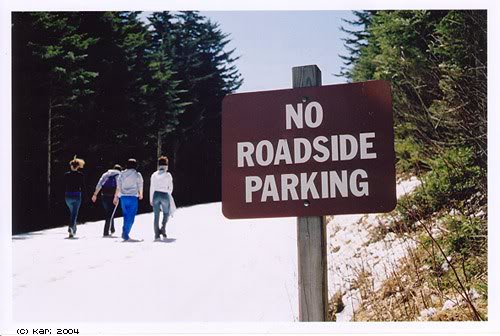
Wordless Wednesday: Spring break 2004

| No comments:
No Parking


For more Wordless Wednesday, go here.

Tuesday, March 23, 2010

Review: Death by pillows

| 2 comments:
As Martin McDonagh has a new play up in New York, A Behanding in Spokane, I decided to take a look at an earlier work that he had written. The Pillowman is probably McDonagh's most famous play, and for good reason: it has some great anecdotes within, proving the worth (and power) of storytelling; and it is literary, as it affirms the importance of the written word on society and on the individual. Except in this case, the outcome isn't so pleasant.
The Pillowman is a play that takes place in some anonymous totalitarian state; it's about a writer of stories, which actually read more like faerytales. The writer's name is Katurian Katurian Katurian. (He had funny parents, in his own words.) The absurdity of such a name is a strong echo to Kafka's protagonists and even the concept of the anonymous - as with having so many of the same names, it's hard to think that Katurian can be pinned down, that Katurian himself must be elusive. Our protagonist though has fallen into the hands of two detectives, a good cop/bad cop situation, in their own words. Tupolski and Ariel are questioning Katurian about his stories, why they focus on child abuse and dismemberment, what these stories could mean in the grander scheme of things. The name Tupolski makes us want to think that this anonymous totalitarian state is to echo that of the Soviet Republic. The name Ariel makes us want to think that this character is a more vengeful version of Shakespeare's in The Tempest.

As they interrogate him, Katurian hears the screaming of his brother Michal, a mentally handicapped man whom Katurian cares for. We soon find out, after Katurian is brutalised by the police, that Michal was ok, that he was told to scream...and that he's hiding some dark secrets that Katurian didn't know about. And perhaps doesn't want to know about. It makes us question the logic of storytelling, its effects on the reader (or in this case, the listener), and why storytelling for certain writers is more necessary than life itself.

In many ways, The Pillowman feels like a story we've seen before. It has hints of 'The Gospel According to Mark' by Jorge Luis Borges in certain aspects of its torture. It has the flavour of many of Kafka's shorts, the pains of the characters' plights. And it does tie together its multiple narratives and voices like a good Tom Stoppard play. But like the comedy and tragedy of his Martin McDonagh's first feature film, In Bruges, the drama unfolds unrelentlessly, painfully - even through the laughs.